ENVIRONMENTAL INFORMATION
ESRS E4 Biodiversity and ecosystems
SBM – 3: MATERIAL RISKS AND OPPORTUNITIES AND THEIR INTERACTION WITH THE STRATEGY AND BUSINESS MODEL(S)
To identify material impacts, dependencies, risks and opportunities and their interaction with the strategy and business model Ferrovial followed the Taskforce on Nature-related Financial Fisclosures (TNFD) and its LEAP (Locate, Evaluate, Assess and Prepare) approach.
In accordance with the LEAP methodology, the Company has identified its business lines that negatively impact biodiversity-sensitive areas (roads, waste treatment plants and landfills, water treatment and desalination plants, photovoltaic solar parks, wind farms and transmission lines) and priority locations for the entire Company.
| Stage* | Description | Likelihood of occurrence |
Time horizon |
|
| Direct impact drivers of biodiversity loss | ||||
| (-) Impact | OP, Pt, C | Loss of biodiversity and natural capital in construction and surrounding areas as a result of large-scale infrastructure projects. | Current | S |
| (+) Impact | OP, Pt | Conservation and respect for the natural environment, under the principle of “no net loss of biodiversity”, seeking to minimize and compensate for the negative impacts of activities thanks to environmental planning and the commitments undertaken. | Current | S |
| Impacts and dependencies of ecosystem services | ||||
| Risk | OP, Pt | Scarcity of certain ecosystem services on which the Company depends to carry out its activities, as well as the alteration in the extension and condition of ecosystems. | S | |
* OP: Own operations; VC: Value Chain; Pu: Purchases; C: Customers; Pt: Partners; S: Short term; M: Medium term; L: Long terms.
Priority locations
Ferrovial currently operates in 8 countries where it interacts with nature, either because they classified as priority locations or because they interact with other natural spaces, even if they are not in their vicinity.
Priority locations are defined by different and recognized international standards (TNFD, GRI) as those that are located in or near sensitive areas (depending on the type of infrastructure, between 60 meters and 1 kilometer). Sensitive areas are:
- Areas of importance for biodiversity
- Areas of high ecosystem integrity
- Water-Stress Areas
- Areas important for the provision of ecosystem services (indigenous communities and FAO Globally Important Agricultural Heritage Systems).
These priority locations are those infrastructures assets in which Ferrovial is the long-term developer, owner and/or concessionaire (over 20 years). They have been geographically located in order to later identify their relationship with sensitive areas. Consequently, Ferrovial has the following priority locations:
| Location | Country | Location | Country |
|---|---|---|---|
| Isle of Wight | United Kingdom | Bio Bio – Araucanía | Chile |
| Milton Keynes | United Kingdom | Coquimbo | Chile |
| Calatayud – Alfajarín | Spain | Gerena | Spain |
| San Cugat del Vallés-Manresa | Spain | Utebo (Zaragoza) | Spain |
| Beltway-Gainesville | United States | Ceuta | Spain |
| Dallas | United States | Drachowo | Poland |
| Dalaman | Türkiye | Kamieńsk | Poland |
In addition to the priority locations, Ferrovial interacts with nature in other places considered sensitive in infrastructures where it does not have ownership, or the project is of shorter duration. These other locations that could be affected include approximately 254 locations (154 in 2024).
Detailed information on this can be found in the next section. More information about the evolution of other locations interacting with nature in section BP-2.
Impacts and dependencies
As part of the negative impacts identified by means of the double materiality assessment, the main impacts on biodiversity and ecosystems Ferrovial’s activities may generate are:
- GHG emissions
- Land use or land occupation, which can lead to:
- Soil degradation
- Deterioration of ecosystem condition
- Habitat fragmentation
- Generation of large volumes of waste
These activities also depend on ecosystem services, which support project delivery and operational resilience, mainly in:
- Key natural resources, such as water.
- And ecosystem services related to climate regulation, soil stability (erosion control), and flood and storm protection.
For more information about the affected sensitive areas in terms of impacts on biodiversity and endangered species, see section “E4-5 Disclosure Requirements: Impact Metrics Related to Biodiversity and Ecosystem Changes”.
It is worth mentioning that the Company has a procedure called “Go / No Go” that was approved to define a series of environmental criteria (based on the International Union for Conservation of Nature, known as IUCN), the Green List of Protected and Conserved Areas, the Universal Declaration of Human Rights of the United Nations and the United Nations Educational, Science and Culture (UNESCO) World Heritage List that must be taken into account when making decisions on whether or not to implement a new project. In this way, the Company assesses the validity of the project location in the context of certain protected areas:
- UNESCO World Heritage Areas: Projects located in, crossing, or adjacent to a World Heritage Site, category IX and/or X, require additional due diligence and analysis.
- IUCN Protected Areas: If a project is located within, crosses or is adjacent to one of the following IUCN protected areas, further due diligence and analysis will be required:
- Strict Nature Reserve (Ia)
- Wilderness Area (Ib)
- National Park (II)
E4 – 1: TRANSITION PLAN AND CONSIDERATION OF BIODIVERSITY AND ECOSYSTEMS IN STRATEGY AND BUSINESS MODEL
Aware of the key role that biodiversity plays in providing services that sustain the economy and social well-being, Ferrovial acknowledges its responsibility to nature and is committed to its protection and conservation. The objective of the Biodiversity Policy is to define and establish the principles and criteria that govern actions related to biodiversity across the Company’s activities and value chain.
In this way, the Company integrates nature-related considerations into its strategy and decision-making, with a Biodiversity Policy embedded into the management system that governs the organizational and operational processes of all its contracts. The objective of this policy is to define and establish the principles and criteria that govern actions related to biodiversity across the Company’s activities and value chain. This policy articulates the organization’s principles regarding:
- Conservation and protection of species and natural ecosystems
- Application of the mitigation hierarchy criteria for negative impacts
- Responsible use of natural resources
- Combating deforestation
- Implementing nature-based solutions
- Integrating natural capital considerations into Risk Management
- “No Net Loss”, working to achieve a “Net Positive Impact”
RESILIENCE ANALYSIS
To analyze its resilience, Ferrovial has followed the recommendations of the TNFD, for which a methodology based on the LEAP (Locate, Evaluate, Assess, Prepare) approach has been developed. This methodology has a broad scope that includes both direct operations and the value chain, and focuses on the assessment of physical, systemic and transition risks, also considering specific and priority locations for biodiversity and ecosystem conservation.
Firstly, Ferrovial identified its priority locations and to this end it considered the infrastructure assets for which it is the developer, owner or has a long-term concession (over or equal to 20 years) and evaluated their interaction with nature (the so-called biodiversity sensitive areas). These infrastructure assets correspond to the Company’s different activities (priority locations can be found in this report in the section “ESRS E4 SBM-3 Disclosure Requirement: Material Impacts, Risks and Opportunities and their Interaction with Strategy and Business Model”).
Impacts and dependencies were then identified and assessed using public tools such as ENCORE or the WWF Risk Filter and the expertise of the Company’s environmental experts. Impacts and dependencies were prioritized in order to identify related risks and opportunities for all of the Company’s activities.
The analysis took into account physical, transition and systemic risks, as well as the Company’s impact and risk management measures on corporate strategy. The risk assessment was carried out following the Ferrovial Risk Management (FRM) process.
To address this resilience analysis, and in the absence of relevant standardized scenarios, guidance provided by the TNFD were used. The scenario analysis proposed by this framework defines a number of plausible futures defined by critical uncertainties and based on compliance with the Kunming–Montreal Global Biodiversity Framework. These scenarios are the following:
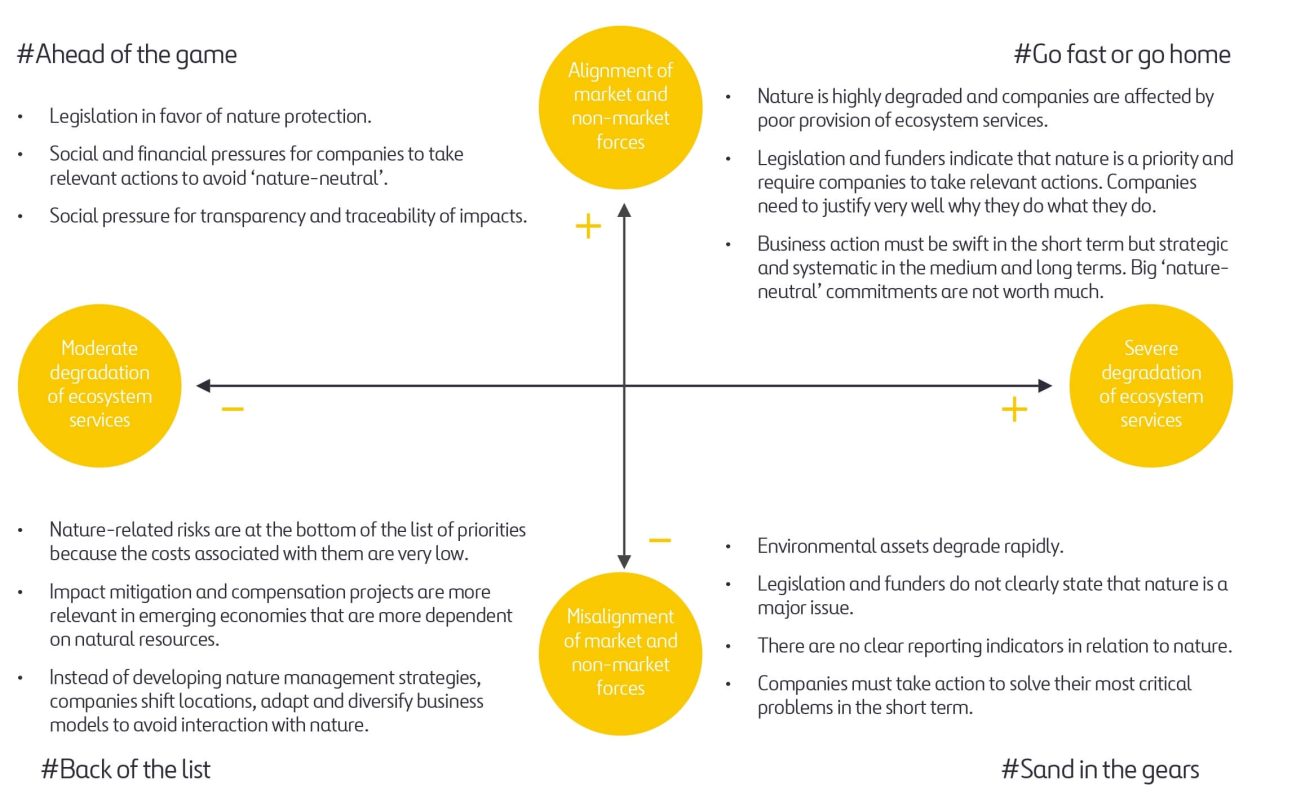
The scenarios have been analyzed taking into account three time horizons:
- Current situation
- Medium-term (2030)
- Long-term (2050)
These horizons are used to assess nature-related risks and are aligned with the horizons analyzed for climate risks. In this way, the climate-nature interaction is studied, and the Company’s resilience is improved.
Following the resilience analysis carried out, Ferrovial has identified nature-related risks, as well as the measures implemented by the Company to mitigate their impacts:
| Physical risks: Nature-related physical risks are risks resulting from the degradation of nature (such as changes in ecosystem equilibrium, including soil quality and species composition) and the consequential loss of ecosystem services that the economic activity depends upon. | ||
|---|---|---|
| Nature scenarios | Main nature risks | Mitigation and/or adaptation measures |
|
These risks could potentially have an impact on operational costs or extraordinary cost. |
|
| Transition risks: Nature-related transition risks are risks to an organization that stem from a misalignment of economic actors with actions aimed at protecting, restoring, and/or reducing negative impacts on nature. | ||
|---|---|---|
| Nature scenarios | Main nature risks | Mitigation and/or adaptation measures |
|
These risks could potentially have an impact on operational costs, extraordinary cost or the Company’s share price. |
|
In addition to the aforementioned mitigation measures, the Company manages its risks and impacts through its FRM process. Additionally, Ferrovial has a Biodiversity Policy in place addressing the conservation of species and ecosystems, the impact mitigation hierarchy, the responsible use of natural resources and the integration of natural capital in risk management, and which is guided by the principle of “no net loss” working towards a “net positive impact”.
FORMULATION OF ASSUMPTIONS
The main assumptions formulated by Ferrovial in relation to the resilience of its strategy and business model with respect to biodiversity and ecosystems are the following:
- Impact on natural capital: Ferrovial’s projects and infrastructures are expected to have an impact on natural capital, including biodiversity and ecosystems. To minimize these impacts, the Company is aware that it is possible to adopt measures that follow the mitigation hierarchy, aimed at avoiding impacts, minimizing them, restoring affected ecosystems, and compensating for those effects that cannot be avoided.
- Mitigation hierarchy and “no net loss”: Ferrovial assumes that environmental management must be guided by the principle of “no net loss” of biodiversity, working towards a “net positive impact”. According to this assumption, it is considered that negative effects on biodiversity can be neutralized through effective impact compensation, which is integrated into the development of projects after the application of Environmental Impact Assessments (EIAs) where appropriate.
- INCA Methodology: The Company is guided by the premise that it is possible to effectively evaluate site design and selection alternatives using the INCA (Integrated Natural Capital Assessment) methodology. This tool allows the Company to measure impacts on biodiversity and evaluate options so as to minimize them. It is considered that the integrated analysis of natural capital allows for decisions to be made that mitigate impacts on ecosystems.
- Climate change as an additional factor: Climate change is considered an element that aggravates the vulnerability of ecosystems and biodiversity. This scenario includes an assessment of how future climate changes, such as extreme temperatures and changes in precipitation patterns, will affect biodiversity and, therefore, the resilience of the infrastructures that Ferrovial operates and manages.
- Participation and consultation of local communities: Another relevant assumption is that the active participation of local communities and other stakeholders contributes positively to the planning and management of projects that impact on biodiversity. Consultation and collaboration are deemed key to ensuring an inclusive and sustainable approach. Stakeholder engagement takes place primarily through consultation when Ferrovial undertakes a developer role, and through collaboration especially in projects where the Company acts as a builder, ensuring that local perspectives are integrated into decision‑making processes.
These assumptions are integrated into Ferrovial’s Sustainability Strategy and project planning, ensuring that biodiversity‑related risks are effectively managed to contribute to the long‑term resilience of its operations and activities.
These results reflect Ferrovial’s commitment to sustainability and environmental protection, aligning its activities and operational processes with best practices to ensure the conservation of biodiversity and the resilience of its operations to environmental risks.
E4 - 2: BIODIVERSITY AND ECOSYSTEM-RELATED POLICIES
| Policy | Biodiversity Policy |
|---|---|
| Description | Ferrovial, through its Biodiversity Policy, seeks to protect and promote biodiversity as an essential element to social and economic well-being, by applying its principles to all the Group’s companies and subcontractors. The policy includes regulatory compliance, conservation and protection of sensitive areas, responsible management of natural resources, combating deforestation, integrating biodiversity into risk management practices, and setting clear monitoring targets, thus addressing the Company’s main impacts and risks associated with nature. It also promotes education, awareness-raising actions, and collaboration with stakeholders to advance biodiversity conservation and protection on a global scale.
With regard to the responsible use of natural resources, Ferrovial promotes eco-efficiency and guarantees traceability across the value chain of the products and raw materials used in its projects. As part of its commitment to the fight against deforestation, the Company establishes the acquisition of certified wood as a principle, which guarantees that materials come from sustainable and responsible sources, as well as the restoration and reforestation of degraded areas. The Biodiversity Policy also addresses training, awareness-raising actions and dissemination as key elements for the protection of biodiversity. Ferrovial promotes stakeholder education and awareness throughout all phases of its projects, ensuring that both employees and strategic partners understand and apply the principles of the policy. The Company also strengthens collaboration with different stakeholders, such as governments, local communities and conservation organizations, to develop global strategies and actions that promote awareness, conservation and protection of the natural capital and biodiversity. The Environmental Impact Statements (EIS), which are applicable to certain projects that may have an impact on biodiversity, take into account the social impacts arising from the alteration of the environment and seek the collaboration of stakeholders for the development of the project. Ferrovial will ensure that the principles set out in this policy are applied in all subsidiaries in which it holds an interest. The Company strives to avoid, minimize and compensate for any negative impact on biodiversity, including activities that seek to combat deforestation, preserve ecosystems affected by its operations (such as soil degradation) and protect affected fauna, all through specific measures and actions. This policy considers aspects related to climate change, the circular economy and the use of water, as it derives from the Quality and Environment Policy that includes all the Company’s environmental aspects. |
| Objective | Ferrovial acknowledges the key role biodiversity plays in providing ecosystem services that underpin the economy and social well-being. The goal of this policy is to define and establish the principles and criteria that govern actions with respect to biodiversity in the Company’s activities and in the value chain. |
| Associated material impacts, risks and opportunities |
|
| Follow-up and remediation process | Ferrovial deploys its policies through the corresponding strategies, which in turn provide governance schemes and indicators with objectives and monitoring procedures that allow ongoing monitoring and evaluation of biodiversity management. These include measures to reduce impacts, as well as to restore and compensate for negative effects on ecosystems, applying a mitigation hierarchy that prioritizes avoiding, minimizing, restoring and compensating for impacts. |
| Scope of the policy | |
| Affected stakeholders | The vision for this policy is to create value for the Company and its customers, investors and employees.
It also promotes engagement and collaboration with different stakeholders to promote global strategies and actions to raise awareness and protect biodiversity.
|
| Geographic areas | Global.
The Biodiversity Policy covers operational sites that are owned, leased or managed by Ferrovial, including those located in or near biodiversity-sensitive areas. The policy, approved by the Quality and Environment Steering Committee, is integrated into the management system and governs the operational processes of all contracts. |
| Value chain application | The objective of the Biodiversity Policy is to define and establish the principles and criteria that govern actions related to biodiversity in the Company’s activities and throughout the value chain. |
| Exclusions from application | There are no exclusions of application. |
| Policy approval flow | |
| Responsible party | The Board of Directors approves the Sustainability Policy, which is implemented through other more specific policies such as the Quality and Environment Policy and the and the Biodiversity Policy (both of which are implemented by the Quality and Environment Committee). |
| Other issues to report (if applicable) | |
| Consistency with third-party instruments or standards | United Nations Convention on Biological Diversity, Taskforce on Nature-related Financial Disclosures (TNFD), Kunming-Montreal Global Biodiversity Framework (GBF), Convention on International Trade in Endangered Species of Wild Fauna and Flora (CITES). |
| Stakeholder engagement | Fostering the relationship with the different stakeholders to promote global strategies and actions for awareness-raising actions, conservation measures and the protection of biodiversity. |
| How it is made available | This policy is available on Ferrovial’s website (ferrovial.com) and through the relevant internal communication channels. |
| Significant policy changes | N/A – no changes have been made. |
This policy comprehensively addresses the Company’s main impacts and dependencies on the natural environment, such as:
- Impact on endangered species and protected areas.
- Land occupation and degradation resulting from construction and infrastructure activities.
- Dependence on key natural resources, such as water and ecosystem services related to climate regulation and soil structure (erosion).
The policy establishes the mitigation hierarchy as a core principle, which guides the Company’s actions towards avoiding, minimizing and compensating for environmental impacts, ensuring compliance with current regulations, including Environmental Impact Statements (EIS) and other equivalent instruments.
In addition, the policy integrates nature-related risks into the Company’s global risk management through Ferrovial’s Risk Management Model. In doing so, the management of biodiversity and natural capital is incorporated in a structured way into the organization’s strategy and decision-making, enabling the proactive identification and mitigation of environmental risks.
The policy applies to all the Company’s activities and extends its principles across the supply chain through the Suppliers’ Code of Ethics, which reinforces Ferrovial’s commitment to the conservation of biodiversity, particularly in sensitive locations. As indicated in its purpose, it defines and establishes the principles and criteria that govern actions in the field of biodiversity, integrating natural capital into decision-making by systematically identifying and assessing dependencies, impacts, risks and opportunities across the entire value chain.
Overall, this policy reflects an integrated and strategic vision that combines the protection of nature, responsible management of resources and ongoing dialogue with stakeholders, effectively contributing to the sustainability of Ferrovial’s operations and the long-term preservation of the ecosystems in which it operates.
E4-3: ACTIONS AND RESOURCES RELATED TO BIODIVERSITY AND ECOSYSTEMS
In relation to the Biodiversity Policy, Ferrovial applies mitigation and conservation criteria in its projects to ensure protection and restoration of the affected ecosystems, which represent the core principles for reducing the environmental impact of its activities.
Specifically, the Company implemented actions to address environmental challenges related to biodiversity and ecosystems. When a project has an Environmental Impact Assessment (EIA), Ferrovial applies the required measures in line with the impact mitigation hierarchy, some of which are compensatory. However, Ferrovial has not implemented any biodiversity offset measures as part of its action plans to date. These actions are carried out on an ongoing basis depending on the type of project.
The following actions carried out in 2025 stand out:
Environmental integration of concrete slopes with substrates and special hydroseeding projections in the Oural tunnel (between Monforte and Lugo).
The presence of slopes and cuttings covered with shotcrete and, occasionally, other support systems, is common in transport infrastructure projects around the world. In many cases, they are simply left untreated and, at best, subject to environmental or landscape integration measures, which usually consist of staining or oxidation treatments of the concrete surface (to make it blend with the environment) and, on other occasions, meshes and/or geocells filled with organic substrate and suitable vegetation are installed (this solution requires continuous and intensive maintenance so as to ensure that the surface of the concrete is more harmonious and it. does not detach or unhook). In addition, over the years, the substrates used in the geocells as a nutrient base for the planted vegetation are washed and depleted. As a result, shotcrete slopes typically have a significant visual impact and offer very limited potential for long-term vegetation restoration.
Ferrovial has implemented a new innovative treatment to be applied to shotcrete slopes with the aim of achieving environmental and landscape integration, addressing the limitations described in the previous paragraph and finding a more sustainable solution than the one offered by current methods. The conditions for plant survival on these concrete surfaces are very challenging and complex, so the Company designed it based on the following principles:
- The use of a high-adhesion substrate, enabling effective attachment to this type of surface, while providing the right nutrients and environment for the initial development of the seeds.
- The definition of a seed mix composed of species that have lower nutritional requirements. The objective is not an “explosive” vegetative growth, but rather stable and durable fixation in the substrate on the concrete allowing gradual environmental integration of the slope. The proposed mix is based on bryophytes (mosses) and lichens, as they require less humidity and shade.
This approach has been term “ecological hydroseeding”, as this treatment is designed to be more stable and sustainable over time than current solutions, requiring little maintenance, without causing infrastructure problems and avoiding the long-term generation of plastics and microplastics in the environment associated with meshes or geogrids.
The implemented solution is expected to deliver more significant results in the medium and long term, since these are slow-growing species. However, it will lead to a greater consolidation of the vegetation cover, as the resilience and adaptability of the cryptogams used may, over time, allow for a more stable and functional colonization of the substrate, contributing to moisture retention and the establishment of microhabitats that facilitate the appearance to other pioneer organisms.
Construction of an artificial reef at Port Olímpic, Barcelona
Coastal areas adjacent to large urban centers face growing environmental pressure. Pollution from urban runoff, wastewater discharges, maritime traffic, coastal construction, and microplastics significantly degrades marine habitats, disrupts biodiversity, and threatens ecosystem services that are essential for both human well-being and climate resilience. In densely populated coastal cities, these impacts are often intensified, leading to habitat loss, reduced water quality, and a decline in marine species.
To address this challenge, Ferrovial is leading the restoration of marine ecosystems in Barcelona through the construction of an innovative artificial reef at Port Olímpic. The project combines advanced engineering, nature-based solutions, and scientific monitoring to enhance marine biodiversity and support the long-term regeneration of the coastal environment. The artificial reef is composed of prefabricated biotopes designed to integrate seamlessly with the seabed while creating suitable conditions for marine life to colonize and thrive. In parallel, the project incorporates dedicated infrastructure to monitor ecological evolution and assess its regenerative impact over time. Project phases:
- Advanced biotope design:
Using concrete 3D printing and prefabricated molds, a series of marine biotopes were developed with bioreceptive geometries and textured surfaces specifically designed to promote the settlement of marine wildlife. Five different biotope configurations were created to increase habitat diversity, encourage species interaction, and enhance overall ecosystem resilience. - Sustainable construction and logistics:
The installation process carried out in 2024 was carefully planned to minimize environmental disturbance. Efficient logistics and handling strategies were defined to ensure safe transportation, precise positioning, and secure anchoring of the biotopes on the seabed. This included detailed analyses of lifting operations, seabed characteristics, and marine and weather conditions to reduce impacts during construction and ensure long-term stability. - Monitoring and assessment of regenerative impact:
To evaluate the effectiveness of the artificial reef, underwater cameras and sensor systems were installed alongside the biotopes. This monitoring infrastructure enables continuous observation of colonization processes, species diversity, and ecosystem development.
In 2025, just one year after installation, the results have been highly encouraging: more than 100 marine species have already been identified, demonstrating a significant and rapid positive impact on ecosystem regeneration.
These actions are part of Ferrovial’s broader commitment to sustainability and the preservation of the natural environment, in line with its sustainability strategy and the fight against climate change. The measures implemented by the Company are directly related to the Company’s potential impacts on nature, following the principles of the Company’s Biodiversity Policy (such as the mitigation hierarchy principle) and are focused on achieving the following objectives:
- Promoting the use of nature-based solutions, including the restoration of affected habitats.
- Integrating biodiversity and natural capital issues into decision-making, in line with the recommendations of the TNFD.
- Implementing measures that enhance the Company’s resilience to the risks that the impacts may generate.
- Preserving areas of special protection interest given the importance of their conservation.
Specific local knowledge about the species to be protected and promoted has been taken into account, as well as the local community. However, due to the location of the proceedings, no indigenous populations are located.
For information related to employees working in Quality and Environment departments see section E3 – 2: Actions and Resources related to Water and marine resources, Cadagua, water treatment activities.
E4-4: TARGETS RELATED TO BIODIVERSITY AND ECOSYSTEMS
Ferrovial established several targets related to biodiversity and ecosystems as part of its Sustainability Strategy and Biodiversity Policy. Nature intrinsically encompasses and connects all environmental issues that are core to the sustainability of the planet and, ultimately, to the conservation and protection of ecosystems. . In other words, nature not only includes, but interconnects all environmental dimensions.
For this reason, Ferrovial has set multiple targets linked to key environmental drivers of change affecting the state of nature. These targets relate to reducing GHG emissions, neutralizing 100% of residual GHG emissions by 2050 through nature-based solutions, water footprint targets and targets related to the circular economy and the efficient use of resources (for further information see sections E1-4, E3-3 and E5-3). In addition, the Company set the following specific nature-related targets:
- TARGET 1: Initiate and deepen TNFD-aligned nature disclosures in FY2025, embedding nature considerations into governance, strategy, risk management, and metrics in line with its Biodiversity Policy.
The target covers global operations and material upstream and downstream value-chain activities, and progress is measured against a 2024 baseline, when the first TNFD-aligned report was published, with 2025 focused on refining the disclosures under the Kunming-Montreal Global Biodiversity Framework (GBF) and the TNFD’s recommendations (including its LEAP approach).Given Ferrovial’s commitment to combating deforestation and the protection and conservation of species and ecosystems (principles and objectives of the Biodiversity Policy), Ferrovial published its first report in 2024 following the TNFD recommendations. During 2025, TNFD recognized Ferrovial’s efforts in integrating nature into decision-making processes, and the Company’s report was approved and included in the TNFD’s list of reporting examples, highlighting Ferrovial’s progress in integrating biodiversity into its strategic decisions. - TARGET 2: 100% neutralization of residual greenhouse gas emissions by 2050 through nature-based solutions.
Ferrovial, firmly committed to combating deforestation, set the objective of promoting nature-based solutions to offset its residual emissions. Ferrovial currently develops emission absorption projects (reforestation projects in areas affected by fires or agricultural use, such as the Compensa Project in Torremocha del Jarama, Madrid) and other nature-based compensation projects that, in turn, enhance local biodiversity, taking into account the real needs of the ecosystem and local communities (conservation and sustainable forest management projects).This target is reviewed annually based on the percentage of emissions offset during the financial year with nature-based projects (such as conservation, sustainable forest management, reforestation projects, etc.) and has no base year. In 2025, Ferrovial will has offset 29,062 tCO2e, where 24.7% correspond to nature-based solutions projects. - TARGET 3: Application of the “Go / No go” procedure to 100% of the projects of the subsidiaries controlled by Ferrovial exceeding a significant budget.Given that Ferrovial is committed to the protection and conservation of species and ecosystems (principles and objectives of the Biodiversity Policy) the potential impacts related to the occupation of protected areas, Ferrovial has set the target of defining a series of environmental criteria to be taken into account when making decisions on whether or not to carry out a new project. This procedure assesses the validity of the project’s location in the context of certain protected areas (for further information on this procedure, see the section “ESRS E4 SBM-3 Disclosure Requirement: Material Impacts, Risks and Opportunities and their Interaction with Strategy and Business Model”).This target is reviewed annually by identifying projects likely to be subject to this procedure (by the type of project in terms of a given budget) and, due to its nature, it does not have milestones, intermediate objectives or base year.
These targets are in line with the Company’s Sustainability Strategy. Additionally, they remain under continuous development to establish other objectives that may be relevant to Ferrovial and nature.
The Company assessed and aligned these targets with significant impacts, dependencies and risks, such as:
- Impact on GHG emissions
- Occupation of protected areas
- Impacts on protected species
- Dependence on climate regulation
- Water dependence
- Reliance on flood and storm protection and mass stabilization
The biodiversity and ecosystem targets have a global scope across the geographies where the Company operates and are directly linked to the most significant aspects identified through the double materiality assessment, which in turn took into account the participation of stakeholders (as described in the section “Disclosure Requirement related to ESRS E4 IRO-1 Disclosure: Description of processes to identify and assess material biodiversity and ecosystem-related impacts, risks, and opportunities. The Company analyzes trends and requirements from analysts and investors, considered when setting these targets, and continuously evaluates the effectiveness of its biodiversity and ecosystem targets and initiatives through internal evaluations.
Targets can be classified into different levels based on the impact mitigation hierarchy:
| Mitigation hierarchy level | Target |
|---|---|
| Avoidance | Application of the “Go / No go” procedure to 100% of projects of subsidiaries controlled by Ferrovial that exceed a significant budget threshold. |
| Minimization | GHG emissions reduction targets. |
| Water footprint targets: Business Water Index (BWI) reduction. | |
Targets related to the circular economy and the efficient use of resources:
|
|
| Commitment to initiate disclosures aligned with TNFD recommendations for FY2025. | |
| Restoration and rehabilitation |
Neutralizing 100% of residual greenhouse gas emissions by 2050 through nature-based solutions. |
| Compensation or offsets | Neutralizing 100% of residual greenhouse gas emissions by 2050 through nature-based solutions. |
| Water footprint targets: annual compensation of 70 times the Business Water Index. |
To develop these goals, Ferrovial used the Kunming-Montreal Global Biodiversity Framework (GBF), as well as the EU’s 2030 Biodiversity Strategy; however, no ecological thresholds were applied. The Company is working on the proper TNFD alignment to establish other targets that may be relevant, as well as the possibility of using Science-Based Targets for Nature (SBTNs).
The Company did not apply biodiversity offsets when setting targets.
More information on these targets can be found in the section “Disclosure Requirement E1-4: Targets related to climate change mitigation and adaptation”, “Disclosure Requirement E3-3: Targets related to water and marine resources” and “Disclosure Requirement E5-3: Targets related to resource use and circular economy”.
E4 – 5: IMPACT METRICS RELATED TO BIODIVERSITY AND ECOSYSTEM CHANGE
The metrics related to the main impacts are the following:
- Species listed on the IUCN Red List and national conservation lists whose habitats are in areas affected by operations.
| 2024 | 2025 | |||
|---|---|---|---|---|
| Conservation status of the species | IUCN Red List | Regional or local list | IUCN Red List | Regional or local list |
| Critically Endangered (CR) | 15 | 14 | ||
| Endangered (EN) | 25 | 20 | ||
| Vulnerable (VU) | 35 | 41 | ||
| Near threatened (NT) | 46 | 41 | ||
| Least concern (LC) | 407 | 436 | ||
| Other categories | 102 | 4 | 114 | |
| TOTAL | 528 | 102 | 556 | 114 |
Priority locations
Ferrovial identified priority locations and other locations interacting with nature, analyzing whether they were within or near biodiversity sensitive areas. In 2025, Ferrovial detected 113 sites within or near protected areas or key to biodiversity, with a total of 9,457 hectares6. For more information about how priority locations are defined, see section ESRS SBM-3: Material Impacts, Risks And Opportunities And Their Interaction With Strategy And Business Model.
| Priority locations | |||
| Name of the protected area | Country | Name of the protected area | Country |
| Isle Of Wight Area Of Outstanding Natural Beauty | UK | Ecological Corridor of the Guadiamar River | Spain |
| Parkhurst Forest | UK | Groves and Mejanas del Ebro | Spain |
| Floodplain Forest Nature Reserve | UK | El Castellar | Spain |
| Hoces del Jalón and Jalón River Gorges | Spain | Calamocarro-Benzú | Spain |
| Muelas del Jiloca: El Campo and La Torreta | Spain | Maritime-terrestrial area of Monte Hacho | Spain |
| Sierra de Vicort | Spain | Rocky Run Stream Valley | US |
| Montes de Alfajarín – Saso de Osera | Spain | Cub Run Stream Valley | US |
| Sant Llorenç del Munt i l’Obac | Spain | Dalaman Wetland | Turkey |
| Montserrat-Roques Blanques-riu Llobregat | Spain | Dalaman Plain Irrigation | Turkey |
| Other locations Interacting with nature | |||
| Location | Country | Location | Country |
| Archaeological site | Chile | The buffer zone of the Tri-City Landscape Park | Poland |
| Archaeological Site HA-DG-02 | Chile | The Middle Vistula Valley | Poland |
| Cerro Santa Inés and Costa de Pichidangui | Chile | The valley of the Sota River | Poland |
| Chilean Palm Area of Monte Aranda | Chile | The Warta and Lower Noteć Valleys | Poland |
| Choapa River Mouth | Chile | Tri-City Landscape Park with buffer zone | Poland |
| Choros Island – Damas Island | Chile | Trzebiatów Coast | Poland |
| Conchalí Lagoon | Chile | Tuchola Forest | Poland |
| Estero Derecho | Chile | Vistula Landscape Park | Poland |
| Fray Jorge Forests | Chile | Warsaw Protected Landscape Area | Poland |
| Gaviota Island | Chile | Warta Valley Poznań section | Poland |
| Historical Monument “Pampa Unión” | Chile | West Pomeranian Coasts | Poland |
| Humboldt Penguin | Chile | Western Zielona Góra Forests | Poland |
| Lagunillas Gorge (Adelaide Lagoon) | Chile | Wisłok Środkowy with tributaries | Poland |
| Los Almendros Gorge to Pachingo Gorge (Tongoy Bay) | Chile | Zakol Zakroczyskie | Poland |
| Mouth of the Limari River | Chile | 91EO Florestas aluviais of Alnus glutinosa e Fraxinus excelsior (Alno-Padion, Alnion incanae, Salicion albae) | Portugal |
| Pichasca | Chile | 9230 Galician-Portuguese Carvalhais of Quercus robur and Quercus pyrenaica | Portugal |
| Punta Choros Marine Reserve | Chile | 92AO Forests-galleries of Salix alba and Populus alba | Portugal |
| Punta Teatinos – Caleta Hornos | Chile | Guaynabo River | Puerto Rico |
| Punta Teatinos to El Culebrón estuary | Chile | Puerto Nuevo River | Puerto Rico |
| Quebrada de Culimo | Chile | 1410 Mediterranean saline grasslands (Juncetalia maritimi)-habitat of interest | Spain |
| Quebrada Llau | Chile | 1510 Mediterranean salt steppes (Limonietalia)-habitat of interest | Spain |
| Quilimarí River Mouth | Chile | 1520 Iberian gypsycola vegetation (Gypsophiletalia)-priority habitat | Spain |
| Raja de Manquehua – Poza Azul | Chile | 4090 Endemic oro-Mediterranean heaths with gorse-habitats of interest | Spain |
| Rocky glacier in Salamanca Commune | Chile | 5330 Thermo-Mediterranean and pre-aesthetic shrublands | Spain |
| Socotoco Gorge | Chile | 6220 Sub-steppe areas of grasses and annuals of the Thero-Brachypodietea-habitat of interest | Spain |
| Talinay Hill | Chile | 6310 Pernnophilous pastures of Quercus spp-habitat of interest | Spain |
| The Chinchillas | Chile | 6430 Hygrophilous eutotrophic megaphorbia of the plain edges and from the montane to alpine floors | Spain |
| The Salt Flats of Huentelauquén | Chile | 92A0 Gallery forests of Salix alba and Populus alba | Spain |
| Tongoy Estuary and El Romeral Creek | Chile | 9340 Holm oak groves of Quercus ilex and Quercus rotundifolia | Spain |
| Tongoy Wetlands | Chile | Arroyo de la Salina and Almanzora River. | Spain |
| TSB-3 tropera footprint | Chile | Banks of the Arlanzón River and tributaries (ES4120072) | Spain |
| Vegas de Quebrada Las Hualtatas | Chile | Banks of the Tebas River and tributaries | Spain |
| Vegas de Tambo | Chile | Barbaon and Calzones Creeks (Arroyo Grande) | Spain |
| Iron Mountains National Geopark | Czech Republic | Barranco de La Aldea | Spain |
| Krounky and Novohradky Valley Nature Park | Czech Republic | Barranco de La Palma | Spain |
| Local biocentre en MVN Kutřín | Czech Republic | Barranco del Risco. Lomo de los Canarios-Playa del Risco | Spain |
| Regional Biocentre Šilingův dům | Czech Republic | Barranquillo de los Moros | Spain |
| Regional Biocorridor Šilingův důl – Otradov | Czech Republic | Cabezo Gordo | Spain |
| The floodplain valley of the Končinský stream | Czech Republic | Cabo Roig Marine Area | Spain |
| Watercourse and forest | Czech Republic | Campo de Cartajena | Spain |
| 3150-2 Oxbow lakes and small water bodies | Poland | Cliffs of Mount Hacho | Spain |
| 6510-1 Ryegrass meadow | Poland | Colada de la Gloria | Spain |
| 91E0-3 Lowland Riparian Forest | Poland | Colada de las Galeras | Spain |
| Augustów Forest Biebrza Valley | Poland | Colada del Camino Real | Spain |
| Augustów Forest-Borecka Forest | Poland | Colada del Llano de Llevas | Spain |
| Bay of Puck | Poland | Cordel de L Pozalvez | Spain |
| Biała Lądecka | Poland | Cordel de la Pinilla | Spain |
| Biebrza Marshes | Poland | Cordel del Priego | Spain |
| Biebrza National Park | Poland | Upper Basin of the Manzanares Regional Park | Spain |
| Biebrza Refuge | Poland | Domingo Rubio Estuary Natural Park | Spain |
| Biebrza Valley | Poland | Ebro River | Spain |
| Biebrza Valley-Borecka Forest | Poland | European dry heaths (4030) | Spain |
| Biebrza Valley-Knyszyn Forest | Poland | Gaztelugatxeko Doniene/San Juan de Gaztelugatxe | Spain |
| Bóbr Valley | Poland | Granada Geopark | Spain |
| Borecka Forest – Piska Forest | Poland | Guayedra Archaeological Zone (BIC) | Spain |
| Brodnica Forests – Vistula Valley | Poland | Guayedra Ravine | Spain |
| Brzozówka Valley | Poland | Guayedra Trail of Historical Value | Spain |
| Bydgoszcz Forest | Poland | Guaza Mountain Natural Monument | Spain |
| Central Wietcisa Valley | Poland | Güi Ravine -Güi Grande | Spain |
| Chełmno Landscape Park | Poland | Iberian Plateau | Spain |
| Cistercian landscape compositions of Rudy Wielkie | Poland | Kaminowski National Park | Spain |
| Czernikowskie Forests | Poland | La Mata Natural Park | Spain |
| Dolna Soła Valley | Poland | Lagunas de Palos y las Madres Natural Park | Spain |
| Drawskie and Połczyńskie Lake Districts | Poland | Las Andas Creek, Dilar River | Spain |
| Dresden wilderness | Poland | Lava flow of the Link Branch | Spain |
| Drwęca River | Poland | Lava from Gabia la Chica to Granada | Spain |
| Drwęca Valley | Poland | Lomo de La Aulaga site | Spain |
| Eastern Protected Landscape Area of the Tuchola Forest | Poland | Altabaca Ravine sheepfold | Spain |
| Eastern Tuchola Forests | Poland | Mala Wash | Spain |
| Edge Vistula Valley Zone | Poland | Manzanares River Basin | Spain |
| Ełk Lake District | Poland | Marine area of the Ría de Mundaka-Cabo de Ogoño | Spain |
| Elk Mountains Landscape Park | Poland | Marjal dels Moros | Spain |
| Forest on the Gwda River | Poland | Mata and Torrevieja Lagoons | Spain |
| Głogów Riparian Islands | Poland | Meadows with mills on calcareous, peaty or lemon-clay substrates (6410) | Spain |
| Grasslands in Haćki | Poland | Odiel Dunes | Spain |
| Kacze Łęgi Reserve | Poland | Protected wetland called Baza Wetland (IHA614025) | Spain |
| Kampinos Forest | Poland | Protection of the Mar Menor | Spain |
| Kampinos National Park | Poland | Rambla de Azohía | Spain |
| Kampinos National Park with buffer zone | Poland | Rambla de Chela | Spain |
| Kampinos Vistula Valley | Poland | Rambla del Mergajón | Spain |
| Kartuzy Protected Landscape Area | Poland | Rambla del Predrero | Spain |
| Kashubia | Poland | Ribera del Jarama | Spain |
| Kashubian Landscape Park | Poland | Riera de Rubi | Spain |
| Kashubian South | Poland | Royal Holm Oak String | Spain |
| Kazuńskie Meadows | Poland | Scratch and Guaza | Spain |
| Kiełpińskie Ławice Reserve | Poland | Sella River | Spain |
| Knyszyńska Forest – Augustów Forest | Poland | Serres de Busa-els Bastets-Lord | Spain |
| Kozienicka Refuge | Poland | Ses Salines Natural Park | Spain |
| Lębork Hills | Poland | Sierra Alto de Almagro | Spain |
| Łosiowe Błota Buffer Zone | Poland | Sierra de la Culebra | Spain |
| Łosiowe Błota Reserve | Poland | Sierra Escalona and Dehesa Campoamor | Spain |
| Lower Gwda Protected Landscape Area | Poland | Southwest Regional Park of the Autonomous Community of Madrid | Spain |
| Lower Noteć Valley | Poland | Submerged Coastal Strip of the Region of Murcia | Spain |
| Lower Vistula Valley | Poland | Tamadaba Natural Park | Spain |
| Lubuskie Land – middle | Poland | Tibi Reservoir | Spain |
| Mite | Poland | Torrepacheco Village | Spain |
| Modlin Forts | Poland | Urdaibai Biosphere Reserve | Spain |
| Nature Reserve “Rotuz” | Poland | Urdaibai river network | Spain |
| Nieszawska Vistula Valley | Poland | Urdaibaiko Itsasadarra/Urdaibai Estuary | Spain |
| Noteć Valley | Poland | Vereda de Cantarranas | Spain |
| Noteć Valley Protected Landscape Area | Poland | Vereda de la Cabra | Spain |
| Oak Avenue – Reitweg | Poland | Vereda de Lucena | Spain |
| Oleckie Lakes Protected Landscape Area | Poland | Vereda Fuente Álamo | Spain |
| Polesie – Roztocze | Poland | Vereda de los Villares | Spain |
| Ponds in Brzeszcze | Poland | Western Galician-Cantabrian migratory corridor | Spain |
| Potametumpectianati comb knotweed syndrome in the Gostynia River | Poland | Fethiye-Göcek Special Environmental Protection Area | Turkey |
| Powidzko-Bieniszewski Protected Landscape Area | Poland | Barnes Meadow Local Nature Reserve | UK |
| Powiśla Forests | Poland | Bow Creek Ecology Park SINC | UK |
| Pradolina Reda – Łeba | Poland | Camp 4 – HAL Biodiversity site | UK |
| Protected Landscape Area – Gawik | Poland | Chilterns Area of Outstanding Natural Beauty | UK |
| Protected Landscape Area of the Edge Zone of the Vistula Valley | Poland | East India Dock Basin SINC | UK |
| Protected Landscape Area of the Ełk Lake District | Poland | Gravesend Site forms part of the Thames Estuary and Marshes Site of Special Scientific Interest (SSSI) and Ramsar site | UK |
| Protected Landscape Area of the Wałecki Lake District | Poland | Mayfield Farm – HAL Biodiversity site | UK |
| Przywidzki Landscape Protected Area | Poland | Mid Colne Valley SSSI | UK |
| Raduni Valleys | Poland | Radstone and Helmdon Disused Railway SSSI | UK |
| Radunia River Jar Reserve | Poland | River Cherwell habitat | UK |
| Riparian Stare Stawy | Poland | River Great Ouse Habitat | UK |
| Rospuda Valley (Augustów Forest – Borecka Forest) | Poland | River Thame habitat | UK |
| Śnieżnica Landscape Park | Poland | River Thames and Tidal Tributaries Site of Importance for Nature Conservation | UK |
| Southern Corridor – Pszczyna Forests | Poland | Royal Victoria Dock | UK |
| Southern Corridor – Racibórz Forests-Pszczyna Forests | Poland | Sheephouse Wood Site of Special Scientific Interest (SSSI) | UK |
| Special Habitat Conservation Area Goczałkowicki Reservoir – Vistula Estuary and Bajerki | Poland | TIlbury sealing end compound (SEC) within the Tilbury Power Station Local Wildlife Site (LWS) | UK |
| Świętokrzyska Forest – Vistula Valley | Poland | Upper Nene Gravel Pits | UK |
| Szczebrzeszyn Landscape Park | Poland | Upper Nene Valley Gravel Pits | UK |
| Szumleś | Poland | US Fish and Wildlife Service (USFWS) | US |
| Tenczyński Landscape Park | Poland | WOTUS – US Army Corp of Eng | US |
| The buffer zone of the Kozienice Landscape Park | Poland | Pampa del Tamarugal National Reserve | Chile |
6 Due to methodological changes, it was not possible to obtain accurate data for this indicator for 2024. For more information, see About this report section BP-2 - Reporting errors in previous periods.
- Restoration actions relevant to the ecological value of the habitat or the uniqueness of the restoration: Ferrovial carries out the ecological restoration of the habitats affected by the construction and operation of its infrastructures in accordance with the regulations in force in each country, introducing improvements whenever possible beyond minimum requirements.In 2025, Ferrovial developed 73 restoration actions (89 in 2024) (for more information, please see section “E4-3 Disclosure Requirement: Actions and resources related to biodiversity and ecosystems”).Projects with an Environmental Impact Statement or equivalent document: In 2025, Ferrovial worked on 30 new projects (42 in 2024) subject to an Environmental Impact Statement (or an equivalent document containing measures to reduce the impact on the environment), pursuant to the legal framework of each country.
Land-use change
Given that Ferrovial’s activities have an impact on land use, the Company may contribute to land-use change depending on its role in each project. Where Ferrovial does not act as a developer, land-use change is not attributed to the Company, as it does not hold decision-making authority over site selection or infrastructure design.
Ferrovial identified 9 assets where land-use change occurred since the start of each project. Most of the locations where the Company plays a decision-making role do not result in significant land-use changes, as the projects are primarily located in urban areas. In non-urban location, the main land-use changes identified over time consisted primarily of transitions from cropland and forest land to settlements, and to a lesser extent, from grassland to settlements.