Global Strategy and 2025 Performance
Global Strategy and business units
Global Strategy and Business Units
Ferrovial is a global company focused on the development and operation of sustainable infrastructure. The Company’s business model is based on the integration of its business units (Highways, Airports, Construction and Energy), in which the Construction area supports the concession business with best-in-class engineering capabilities to design and build infrastructure. Ferrovial’s integrated model is present throughout the entire lifecycle of a project, from conceptualization to design, financing, construction, and operation of critical complex projects, such as highways and airports. The Company’s growth focus remains the United States, a market where Ferrovial has worked for more than 20 years. The Company will continue to expand its North American asset base in the coming years.
Ferrovial’s strategy is built on four key priorities:
- People: ensuring the highest standards for health and safety in its operations and implementing innovative technologies to prevent accidents involving users and employees. Ferrovial will continue to attract, develop and deploy the best talent for each position, foster diversity, and actively manage employee engagement. The total workforce of Ferrovial as of December 31 was 22,609. For more detailed information, please refer to S1-6.
- Sustainable growth: developing infrastructure projects with high concessional value in Ferrovial’s core markets, rotating mature assets to realize the value of investments, funding future opportunities, and ensuring maximum return to shareholders.
- Operational excellence: optimizing cash generation while maintaining the highest level of operating performance, improving efficiency, reinforcing risk management, strengthening financial discipline and keeping sustainability at the core.
- Innovation:supporting Ferrovial’s core business, accelerating its digital transformation, fostering an comprehensive innovation and cybersecurity culture and embedding AI within core processes.
Ferrovial’s integrated business model enables the Company to develop and operate innovative, efficient, and sustainable infrastructure projects with high value creation for stakeholders. Our four business units are:
- Highways has a unique infra-asset base that focuses on developing congestion relief solutions, particularly in the US and Canada through dynamic pricing schemes (Managed Lanes, “MLs”). The business will continue to develop MLs and highways in the US, as well as focus on increasing the solid pipeline and pursuing selected projects in other countries, such as India (i.e., the IRB partnership).
- Airport’s value proposition is based on facilitating air transport growth to improve people connectivity as air-traffic increases. The business unit will focus on terminal-related opportunities in the US, airport expansion projects in Europe, and other growth opportunities where Ferrovial’s capabilities represent an advantage.
- Energy is focused on developing projects for the energy transition, including transmission lines and renewable projects in selected markets, mainly in the US.
- Construction is key in supporting other divisions on complex infrastructure projects with end-to-end technical, engineering and production capabilities. The business unit has strong local bases in Texas, Spain and Poland that support other geographies and manage risks from bidding and design to project delivery.
In 2024, Ferrovial created the Digital Infrastructure division, which targets investments in the high-growth data center market, building on a decade of construction of successful projects for industry leaders.
Aligned with Ferrovial’s corporate strategy, in 2025 the Sustainability Strategy was updated to ensure it creates tangible value across all the Company’s divisions, the communities in which it operates, and its stakeholders. Ferrovial Ferrovial seeks to enhance productivity, operational efficiency and excellence, while reducing costs, ensuring compliance and mitigating risks. The Company’s approach focuses on driving long-term competitiveness and resilience through enhancing the positive impact of the Company’s infrastructure, promoting economic development, encouraging community participation in each project, and reinforcing Ferrovial’s ability to attract and retain talent. This strategy strengthens the Company’s relationship with customers and public administrations and helps facilitate compliance with essential requirements, audits, and qualifications —thereby supporting the basis on which Ferrovial operates. Sustainability also expands the financing opportunities through access to alternative instruments, including green and sustainable financing frameworks. All of this drives dedicated response to the expectations of its shareholders and the investment community, as well as the demands of analysts and indices specialized in ESG criteria.
HIGHWAYS
Cintra, Ferrovial’s highway division, strategically focuses its activity on developed markets with high demand for infrastructure, developing projects that enhance users’ quality of life through reliable travel routes and congestion-relief solutions, thus contributing to the socioeconomic development of the regions in which it operates.
STRATEGY
With more than 50 years of experience, Cintra’s comprehensive management model and in-depth knowledge of travel demand forecasting and advanced pricing analytics create significant value. Synergies with Ferrovial Construction further enhance Cintra’s value creation potential and reinforce its strong competitive advantages. Complete project lifecycle management, combined with a diversified and global portfolio, allows Cintra to understand the needs of all stakeholders (users, public authorities, and economic operators), resulting in the ability to provide innovative, sustainable and high value-added solutions.
NORTH AMERICA
CONCESSIONS
KILOMETRES
DIVIDENDS (M€)
INVESTMENT MANAGED* (M€)
- (*) Information on investment under management and the number of IRB (India) and Private Invit asset concessions is not included.
(**) Includes Via-Livre, the electronic toll-collection operator in Portugal, and Bip&Drive, the Via-T electronic tolling provider.
MAIN MARKETS
Cintra has consistently invested in growing and diversifying its portfolio, with a strong focus on the North American markets, where the Company benefits from consistent regulatory frameworks and promising growth prospects, including the recent acquisition of an additional 5% stake in the 407ETR.
Cintra owns 48.29% of the 407 ETR highway in Toronto (Canada); 62.97%, 54.60% and 53.67% of the Express Lanes NTE, LBJ and NTE 35W in Texas (US), respectively. Meanwhile, in North Carolina (US), Cintra holds 72.24% of the I-77 and 55.704% of the I-66 in Virginia (US).
In the Express Lanes, rates are dynamic and can be adjusted every few minutes according to the level of congestion, always guaranteeing a minimum speed for drivers. With free-flow (barrier-free) toll systems, these assets stand out for their long concession duration, broad toll rates flexibility and optimized long-term financial structures, positioning Cintra as a leader in the private development of highly complex road transportation infrastructures.
Cintra also seeks investment opportunities in specific geographies where its business model can generate unique competitive advantages and enhance shareholder value. In 2021, Cintra acquired a 24.9% stake in IRB Infrastructure Developers —now reduced to 19.9% after a 5% sale in June 2024— In 2024, Cintra also acquired a 23.99% interest in IRB Infrastructure Trust.
Cintra aims to offer sustainable projects that address urban traffic congestion and complex greenfield concessions. This approach enables users to save time, improve the reliability of their daily commute, and boost economic productivity, thereby creating new growth opportunities in the regions where Cintra operates.
Beyond North America and India, the Company operates in Europe, South America and Australia where it also holds stakes in various assets and corporations.
VALUE CREATION
High complexity greenfield projects
Cintra specializes in complex greenfield projects due to their high value-creation potential. Its ability to evaluate and take on a higher level of risk associated with projects in the bidding phase (construction, financing, operation and traffic management) allows it to opt for higher rates of return (IRR). Value creation is achieved by decreasing the discount rate of future cash flows as project risks are eliminated during the construction phase or reduced (traffic/financing) as the concession term progresses.
Rotation of mature assets
Value creation is realized through the sale of mature projects, the proceeds of which are invested in new assets with greater potential for value creation. The latest example of this strategy is the agreement reached with Interogo Holding to manage the stakes in a set of concessions in Europe and Canada. Cintra transferred rights and hold majority voting rights in Umbrella Roads BV, which will manage the operations under a service agreement. This partnership could allow for further collaboration between the parties in the future. The sale was completed on October 8, 2024 for EUR 100 million.
Creating sustainable value
Cintra integrates biodiversity and circular economy principles into every asset, ensuring operational efficiency and long-term resilience. By reducing emissions and waste, and restoring habitats, Cintra does not only protect ecosystems but also enhances asset performance and reduces lifecycle costs. Cintra strengthens climate resilience through energy-efficient technologies, adaptive infrastructure, and continuous efforts to minimize its carbon footprint, safeguarding ecosystems for the long run.
Sustainability means ensuring that what drives Cintra’s growth-customers, employees, communities, and shareholders-continues to strengthen every day. Value is created for customers by reducing travel times during peak hours, increasing the reliability of travel, and operating roads to a high standard for safety. Cintra creates value for communities through supporting economic growth and regional prosperity and giving back through volunteer hours and donations. To protect employees, Cintra follows Ferrovial’s “Always Safe, Always Ready” guidance, which provides training and empowers team members to stop work if they feel unsafe or observe unsafe practices. Cintra also partners with top-tier universities, such as the Massachusetts Institute of Technology and the Georgia Institute of Technology, to promote adaptability through research and innovation. Additionally, 100% of Cintra’s portfolio has been assessed for physical climate change risk using the ADAPTARE tool developed in collaboration with the University of Cantabria.
EXPECTED BUSINESS PERFORMANCE IN 2026
For 2025, traffic across the Company’s assets was expected to continue growing, albeit with I-77 traffic having been positively impacted in 2024 by Hurricane Helene, which diverted heavy vehicles to the highway, and NTE affected by ongoing construction works aimed at increasing project capacity. Expectations were met, with toll revenue surpassing 2024 levels, whereby NTE was less impacted than expected, resulting from close collaboration with the contractor helping to minimize disruption in the area.
In 2026, we expect traffic to increase in most of our highway assets, although NTE could be impacted by the ongoing construction works to expand the highway.
Dividends of €880 million were received in 2025, compared to EUR 895 million in the previous year (including the distribution of the first dividend in I-77 and I-66). In 2026, it is expected that the main infrastructure assets are expected to continue to distribute dividends consistently according to their operating performance. Cintra will focus its efforts on maximizing the quality of the service provided, optimizing its revenues and costs, within the framework allowed by the concession contracts. The expected evolution by geography is as follows:
- In Canada, the 407 ETR highway will continue to focus on optimization and cost-control measures without abandoning the development of its user value-generation strategy. The highway will maintain its investment in the Data Lab to improve its understanding of user behavior and personalize its value propositions, as well as to enhance its customer management systems, enabling tailored services through loyalty plans and specific offers.
Under the Schedule 22* of the 407 ETR concession agreement, if annual traffic level measurements fall below the corresponding traffic thresholds, 407 ETR will have to pay potentially significant amounts calculated under Schedule 22 to the province and a potential first payment due in early 2026.
- In the United States, most highways have shown good traffic growth, as well as growth in average revenue per transaction. The soft cap toll rates was increased in January 2026 based on last December CPI compared to the previous year.
Also during 2025, thanks to the success of the North Tarrant Express project, highway expansion work started earlier than initially planned under the development agreement between the Company and the Texas Department of Transportation. Works will continue throughout 2026, with completion expected by the end of 2026. These works are affecting traffic levels, but thanks to the optimal management of the project, the impact felt during 2025 has been lower than expected, with a similar evolution expected through 2026.
- Australia: Cintra will continue to manage the Toowoomba Bypass highway and the Western Roads Upgrade project, which was fully opened to traffic in November 2021.
- IRB, Infrastructure Developers Ltd. manages 27 different toll road projects (plus a letter of award for a new project) approximately 16,900 lane kilometers. And Private InvIT holds a portfolio of 13 toll road concessions, operates in 12 Indian states over a total distance of more than 7,700 lane kilometers.
- Remaining markets: Cintra will continue to operate the assets already in service, including the D4R7 highway in Slovakia, which was fully opened to traffic in October 2021. Several sections of the Ruta del Cacao, in Colombia, will also be opened to traffic. In April 2025, Silvertown Tunnel was fully opened, in the United Kingdom.
The Company will continue its bidding activity in North America with an attractive pipeline for 2026, and in other target regions (Europe, Australia, Colombia and Peru), focusing on complex greenfield projects, due to their high potential for value creation, as well as in India through IRB.
*Certain 407 ETR annual traffic levels are measured against annual minimum traffic thresholds, which are prescribed by Schedule 22 to the concession agreement and escalate annually up to a specified lane capacity.
AIRPORTS
Ferrovial Airports integrates all the Company’s investments in airport activities and is one of the world’s leading private airport operators.
STRATEGY
With more than 25 years of experience in airport investment and development, this business unit continues to grow, always seeking to improve passenger experience and optimize efficiency, increasing passenger numbers in Dalaman and the number of agreements with airlines for the future New Terminal One (NTO) operation, but also continuously analyzing selective potential opportunities that could add value to our business.
During 2025, asset rotation reached a key milestone, divesting from certain assets, and shifting the focus to terminal-related opportunities in the USA and other regions where Ferrovial has a presence.
CASH GENERATION
NTO
DALAMAN
ASSETS
Ferrovial Airports has a significant international presence through its 49% stake in the partnership that will design, build and operate the New Terminal One at John F. Kennedy International Airport in New York, US, as well as its 60% stake in the Company that manages the concession for Dalaman International Airport in Turkey. During 2025, the business unit also had a portfolio of four airports in the UK: a 5.25% stake in Heathrow and a 50% stake in Glasgow, Aberdeen and Southampton (AGS).
In January 2025, following satisfaction of applicable regulatory conditions, Ferrovial completed the sale of its 50% shareholding in AGS for a price of £450 million. This gave rise to a capital gain of €297 million which has impacted the results of Q1 2025.
In July 2025, following the compliance with applicable regulatory conditions, Ferrovial completed the sale of its 5.25% shareholding in Heathrow for a price of £466 million. This gave rise to a capital gain of €27 million, with an impact in 2025.
New Terminal One (NTO) at JFK International Airport
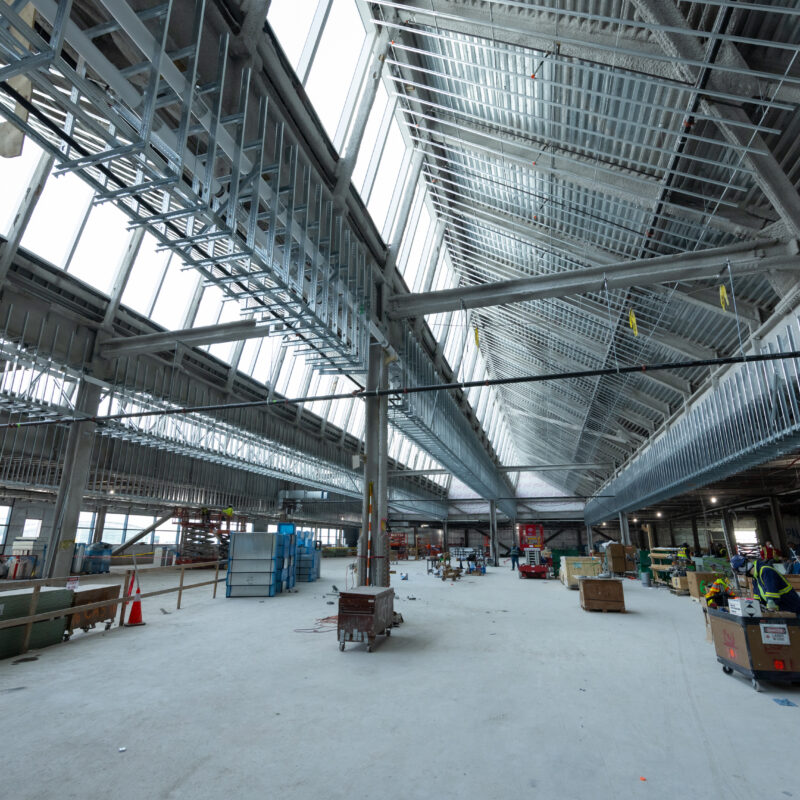
This was a critical year for NTO construction progress and the kickoff of Operational Readiness and Airport Transfer (ORAT) activities. As the year drew to a close, physical construction progress stood at 82% vertical circulation elements were all installed, critical systems like the baggage handling system were installed and underwent testing, and user fit-out of lounge spaces, office spaces, and concessions spaces is well underway. The focus now is on completing physical construction and power and IT systems such that ORAT is completed at the earliest possible date.
Beyond construction, 2025 was also a key year for NTO project financing, with the successful issuance of the Series 2025 Green Bonds. Following the largest-ever municipal bond financing for an airport project in 2024, the $1.367 billion Series 2025 Green Bonds will be used to finance the remainder of the costs related to NTO’s Phase A. Even with a large slate of competing offerings in the market on the day of pricing, investors submitted nearly $4.3 billion in orders for NTO’s Series 2025 bonds. This strong demand enabled the transaction to be repriced, reducing overall borrowing costs.
As of December 31, 2025, there are agreements with twenty five airlines out of which sixteen are airline executed agreements (Air France, LOT, Etihad, KLM, Korean and Turkish, among others), six more than in 2024. In addition, NTO has signed 9 letters of intention with other international carriers and continues in active negotiations with numerous other international airlines as of January 2026.
JFK is the largest international US gateway for aviation by a significant margin and a durable and strong international air traffic market. The NTO project will increase the airport’s capacity to host large aircrafts in an environment with unregulated air charges.
Dalaman
Dalaman Airport remains a major vacation destination for domestic and international travelers in Turkey. During 2025, the tourism industry in Turkey was negatively impacted by macroeconomic factors (persistent high inflation not accompanied by a similar currency devaluation, resulting in higher prices for tourists) and geopolitical factors (conflicts in the Middle East and Ukraine). During 2025, the airport slightly decreased its passenger volume (-1.9% vs. 2024) whilst maximizing associated revenues (+3.6% recurrent revenue).
Dalaman Airport also strengthened its strategic position through three major initiatives: hosting the ACI Europe Regional Airports Conference & Exhibition, achieving ACI Airport Carbon Accreditation Level 3 “Optimization,” and advancing its food and beverage (F&B) transformation project. The congress gathered industry leaders to discuss sustainability and innovation, reinforcing Dalaman’s role in regional connectivity. Meanwhile, the F&B project introduced a redesigned layout with premium concepts and optimized passenger flow to boost non-aeronautical revenue and enhance travel experience.
VALUE CREATION
The Airports Division retains its focus on growth on geographical areas in which the overall business operates. Ferrovial Airports is working towards becoming one of the key pillars of Ferrovial’s future growth through both direct investments and joint ventures.
Innovation and Continuous Improvement
Dalaman
Following the completion of this first phase in 2024, the airport is already advancing into the second phase of the project. The expanded installation will add 10,500 solar panels to the facility’s roof, with an expected annual generation of 9,044 MWh. Installation is currently underway and is expected to be fully operational during 2026.
This project enhances the asset’s resilience by reducing its dependency on the grid, contributes to lowering its carbon footprint (Scope 2 emissions), and delivers significant savings in energy costs.
NTO
Ferrovial Airports, through the MSA contract, is supporting the development and delivery of NTO’s innovation, digital, data, and AI strategies. The development of a logic-driven simulation of the full end-to-end passenger journey and processes using flight schedule forecasts will help with the optimization of the passenger experience through all life-cycle phases.
Numerous business-related use cases and proof of concepts have been improved using agentic AI automation and key digital projects are progressing towards completion including: Roadway & Curbside digital signage, MUFIDs content designs, and the Passenger Information Platform/Digital Assistant.
EXPECTED BUSINESS PERFORMANCE IN 2026
For 2026, traffic is expected to increase in Dalaman Airport and NTO is expected to become operational and increase agreements with airlines, with financial results are expected to follow traffic trends.
Our intention is also to grow our airport investment portfolio globally with a special focus on North America. We expect to prioritize investment opportunities in high-growth leisure and business markets, and we will consider participation in selected open-bid opportunities while as well as bilaterally negotiated projects in which our strong expertise, credentials and partnership approach may provide unique origination advantages.
Dividend distribution in the coming years will largely depend on traffic recovery and business performance.
ENERGY
The Energy Division aims to develop, finance, build, and operate electricity generation, storage, and transmission infrastructure. The division operates selectively in geographies in which Ferrovial is present, with the aim of providing innovative and efficient solutions in a sector that is key to economic growth and well-being.
CONTEXT AND MAIN MARKETS
The energy sector is undergoing a transformation driven by several trends:
- The electrification of the economy and the expansion of artificial intelligence continue increasing electricity demand projections, intensifying the need for new generation, transmission, and distribution capacity.
- The geopolitical relevance of energy security is reinforcing the role of renewable energies and storage as essential infrastructure for reducing reliance on fossil fuel imports.
- The maturity of renewable energy technologies and the industrialization of their supply chains enhance the competitiveness and rapid deployment of renewable generation. Development constraints progressively shift to other parts of the value chain, particularly grid access.
In the United States, following legislative changes introduced in 2025, the regulatory framework for the development of renewable energy projects stabilized in the near term, improving visibility on project economics. Over the longer term, rising electricity demand is expected to sustain the investment needs across generation, storage and transmission infrastructure assets.
In other regions, such as Spain, Chile, and Australia, private development of energy infrastructure will continue to be key to sustaining economic growth and strengthening energy security.
STRATEGY
The Energy Division develops, finances, builds and operates energy assets, with a focus on renewable energy generation, storage, and transmission.
Value creation is driven by the origination and structuring of greenfield projects, as well as by their efficient execution from construction through commissioning. Selective rotation of operational assets enables the realization of value created across the project lifecycle, while supporting capital allocation aligned with Ferrovial’s strategic objectives.
In 2025, Ferrovial Energy acquired a new solar photovoltaic project under development in Texas, increasing the generation portfolio to 550 MW of assets in operation or under construction. The division also increased the level of revenue from EPC contracts in the different business segments where it operates.
VALUE CREATION
Ferrovial Energy operates under an integrated business model that combines investment in assets and the execution of construction projects in the energy sector. Value is generated across the project lifecycle, from development and financial structuring to the definition of the revenue model (predominantly contracted), as well as through the construction and commissioning of the assets. This value creation is realized when the projects are sold to investors seeking assets with reduced risk profiles and predictable cash generation.
Ferrovial Energy has the technical capabilities and experience required to ensure efficient project execution, optimizing the resources used and managing risks. Centered on operational excellence and innovation, the Division incorporates solutions across design, engineering, and construction processes, enabling it to enhance competitiveness and deliver differentiated proposals. This approach applies to both renewable generation and transmission line projects.
ASSETS
In the United States, two photovoltaic plants are currently under construction in Texas, with a combined capacity of 500 MW, and are expected to become operational in 2026 and 2027, respectively. In Spain, the El Berrocal photovoltaic plant is already operational with an installed capacity of 50 MWp.
In Chile, Ferrovial has three operational transmission lines with a combined length of 924 kilometers:
- Transchile Project: acquired in 2016, this transmission line has a total length of 408 kilometers (2×220 kV – 204 km).
- Centella Project: commissioned in 2024, this transmission line has a total length of 504 kilometers (2×220 kV – 252 km).
- Tap Mauro Project: commissioned in 2025, this transmission line has a total length of 12 kilometers (4×220 kV – 3 km).
PHOTOVOLTAIC SOLAR ENERGY
TRANSMISSION LINES
EXPECTED BUSINESS PERFORMANCE IN 2026
- Growth and profitability will be top priority in 2026, supported by continued efficiency enhancements and further alignment of objectives as an integrated unit. These efforts are essential to maximize productivity and achieve the strategic objectives set by the Company.
- Internationally, the division aims to expand its presence in the United States across all business areas. In addition, it is actively participating in tender processes in Australia with the objective of securing contracts in the near term. Sustained growth in Chile is also expected to continue. This selective growth will enable the Company to increase its project portfolio in the United States while exploring additional growth opportunities in other markets.
- The division will also continue to broaden the range of products offered to customers. This comprehensive approach will not only improve customer satisfaction but also contribute to the overall growth and success of the Company.
CONSTRUCTION
Ferrovial Construction is the business unit that carries out the construction of civil works, buildings, data centers, water treatment plants, and industrial works. It is internationally recognized for its ability to design and build unique, innovative and sustainable infrastructure.
STRATEGY
The Construction Division represents an essential cornerstone of Ferrovial’s corporate strategy thanks to its world-class engineering capabilities in the design and construction of complex infrastructure projects. This activity is aimed at supporting other Ferrovial investment divisions, as well as the execution of infrastructure and building projects for public and private clients. The Construction business unit reinforces Ferrovial’s capabilities and strengthens its competitive position in the bidding of concessions, mainly in the transport sector.
In 2025, Ferrovial Construction continued its favorable growth trajectory in revenues and exceeded the average long-term profitability target of Ferrovial’s strategic plan. This performance is driven by the initiatives implemented in recent years aimed at strengthening risk control and management, as well as a more selective policy in the bidding of projects and geographies, prioritizing profitability. Likewise, the commitment to more collaborative contracting models and continued investment in innovation, technology and digitalization contributed to these results.
MAIN MARKETS
Ferrovial Construction focuses its activity on developed countries with stable economies and a firm commitment to the modernization of their infrastructure assets. The United States, Poland and Spain are the division’s main markets, encompassing more than 75% of revenues. Other geographies with a stable presence are the United Kingdom, Chile, Australia and Canada. The order book, at an all-time high, has a balanced risk profile, with adequate exposure to Ferrovial’s key markets and to projects for other companies in the Group.
VALUE CREATION
In addition to its own profitability and ability to generate cash flows, the Construction Division provides added value by taking part from the very beginning of projects through their completion. The division specializes in highly complex technical projects, developed thanks to the experience and international presence of more than 350 employees of its Engineering Services Department, devoted to the delivery of first-class engineering solutions. Sectoral and geographical diversification, and the size of the division allow it to maintain its technical qualifications and have fully prepared material and human teams to support other Ferrovial divisions in the bidding of concessions, providing security regarding price and time, and quality in delivery. This collaboration with Group companies was reflected again in 2025 with the award, together with the Energy Division, of the construction of a 250 MW photovoltaic solar plant in Milam County (Texas, US), which is expected to come into operation in 2027, and in which Ferrovial Energy is also acting as an investor.
ORDER BOOK DEC-25
2025 ADJUSTED EBIT
REVENUE 2025
CASH FLOW FROM OPERATING AND INVESTING ACTIVITIES BEFORE CORPORATE INCOME TAX 2025
Leading Responsibly
Sustainable project management is a priority for Ferrovial Construction. With the ambition of maintaining its leading position, the 2024-2030 Sustainability Strategy was launched to reinforce its commitment towards society and respond to the demands of stakeholders and the ESG regulatory framework. This strategy covers the entire value chain of the Division, collaborating with customers and suppliers to develop more sustainable infrastructures.
In the environmental area, Construction prioritizes the lowering carbon emissions of its activities and the reduction of its impact on the environment. The strategy focuses on the energy efficiency of the fleet and machinery, the use of alternative fuels and electricity sources, and the incorporation of recycled materials. Likewise, the use of technology and the optimization of processes from the design phase to the construction phase are promoted, incorporating solutions such as prefabrication, modular construction and digitalization. At the same time, circular economy principles, waste recycling and the reuse of materials, the reduction of the water footprint, and the tailored management of projects to minimize negative impacts on the natural environment and biodiversity are promoted.
In social matters, the Construction Division maintains its commitment to people and communities, promoting the economic and social development of the communities in which it operates through the involvement of the local supply chain, social action projects, and the creation of direct and indirect employment. In the same way, commitment to its employees is a priority, focusing on the health, safety and well-being of all employees and collaborators, implementing risk control measures, awareness and compliance with the highest health and safety standards, actively involving itself in their achievement, improvement and development at all levels of the organization, incorporating innovation and the use of new technologies, such as sensors and automation of machinery, artificial intelligence for risk analysis or robotics as a support tool. Another key aspect in this area is the attraction, development and retention of talent, providing training and advancement opportunities for employees, and ensuring an environment that fosters equal opportunities.
In the field of governance, Construction is guided by the principles of integrity and transparency in the development of its operations. It seeks to incorporate sustainability measures into processes and decision-making, ensuring respect for applicable legislation, the Code of Ethics for employees and suppliers and the application of anti-corruption policies. During procurement processes, Ferrovial seeks to manage risks in advance by evaluating and monitoring suppliers, customers and partners in accordance with the principles of ethics and integrity, with the aim of detecting possible risks in the financial, environmental, legal, labor and reputational fields.
EXPECTED BUSINESS PERFORMANCE IN 2026
In 2026, stability in sales is anticipated after to the favorable level of revenues in 2025, supported by an order book that has once again reached record levels, with good exposure to key markets and projects for the Group’s companies, in line with Ferrovial’s strategy. In 2026, the investment effort in project bidding is expected to continue in the United States and other geographies, given the strong pipeline of future projects for both other Ferrovial’s divisions and third parties.
In terms of profitability, the average long-term target is expected to be met again, thanks to the risk management measures implemented in recent years and the volume and quality of the order book, which enables a selective approach to tenders, focused on risk mitigation and long-term profitability.
The outlook for 2026, by market, is as follows:
- United States and Canada: following the growth in recent years, revenues are expected to stabilize, supported by the high number of awards obtained by Webber in recent years, which include a number of diverse sectors such as transportation infrastructure, water treatment plants and renewable energy projects in both Texas and the East Coast of the United States, as well as the faster pace of execution of the Ontario Line of the Toronto Metro. In the medium term, stable investment in transportation infrastructure in states and provinces is expected, supported by the US federal infrastructure plan, Infrastructure Investment & Jobs Act, which is realized in concrete investment programs, such as Texas’ new highway plan for the next ten years, Unified Transportation Program 2026, or the Major Mobility Investment Program for large highway projects in Georgia. The Construction Division will continue to support the bidding process for P3 projects of the Group’s investment units, with a particular focus on highway and airport initiatives on the East Coast of the United States.
- Spain: a stable level of sales is anticipated, after the high growth in revenues in recent years. In the medium term, it is estimated that the momentum in the tendering activity will continue, both for public and private clients, where private initiatives in residential construction, industrial construction, logistics, technology and data centers stand out, as well as the sustained public demand for railway, sanitary and water treatment infrastructure projects.
- Poland: revenues are expected to be in line with the previous year, and the selective tendering strategy, focusing on profitability and diversification in sectors such as energy, renewables and the specialized construction of technological and industrial projects, will be maintained. The public tender continues to offer good prospects thanks to the national investment plans for roads and railways, supported by the high level of funds allocated under the European Union’s 2021-27 Multiannual Financial Framework.
- Other international markets: the United Kingdom and Australia stand out, where a moderate drop in revenues is expected mainly due to the lower production of relevant projects in Australia, such as the Sydney Metro, which is scheduled for completion in 2026. This decline has not been offset by the progress of the three contracts for the design and construction of the track infrastructure of the HS2 high-speed project in the United Kingdom, the execution of which is expected to intensify from 2027, once the design phase is completed.