Annex
Additional non-financial information
ADDITIONAL NON-FINANCIAL INFORMATION
This section includes additional non-financial information that is not included in the Statement of Consolidated Non-Financial and Sustainability Information.
QUALITY
The Quality and Environment Policy provides a key lever to drive continuous improvement, technical capabilities and process efficiency. In order to achieve these objectives, Ferrovial implements an efficient management based on innovation and the use of new technologies, offering a unique and high-quality experience to its customers and users, managing all aspects that influence excellent performance.
For this purpose, a unified work method is established, implementing an operating procedure across all contracts to offer products and services that meet quality requirements and consider environmental criteria.
To ensure compliance, the Company has implemented an integrated management system in accordance with quality, environmental and energy criteria across all its contracts, which serves as a tool for complying with the principles defined in its policy.
CERTIFIED ACTIVITY
CERTIFIED ACTIVITY
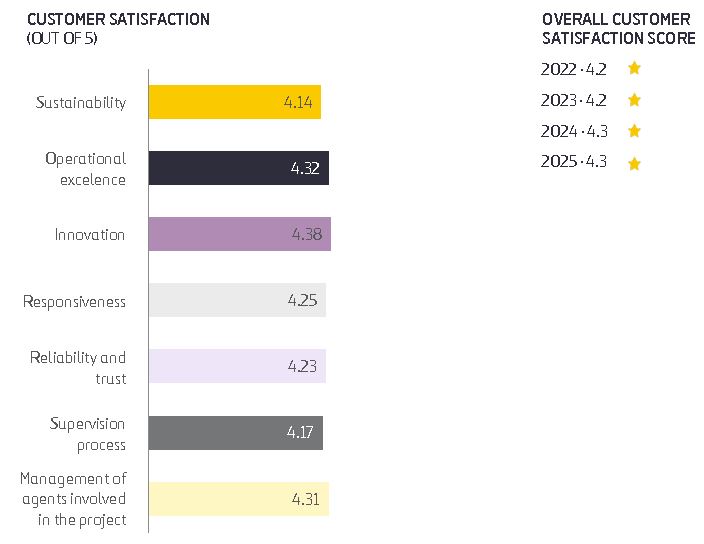
CUSTOMER SATISFACTION
INTEGRATED MANAGEMENT SYSTEM
In 2025, the certified activity reached 86% according to ISO 9001 standard, 86% according to ISO 14001 and 80% according to ISO 50001. The calculation is based on the number of contracts that have implemented these systems coinciding with the taxonomy perimeter. In some cases, services are also certified under other standards due to local requirements. It should be noted that in 2025 Ferrovial Construction UK has increased the number of contracts that are included under the scope of ISO 9001, ISO 14001 and ISO 50001 certifications.
As part of system management, internal audits are conducted, and complaints are recorded in 100% of the contracts. In 2025, 1384 external complaints/communications were received, of which 61% were successfully closed.
OTHER CERTIFICATIONS
Since 2020, Ferrovial has been certified by AENOR on sustainability and business contribution to the Sustainable Development Goals. With this certification, the Sustainability Strategy and the actions performed by the Company in ESG matters are valued, which reinforces its commitment to the SDGs.
SGE 21 certification has been obtained for the Ferrovial Construction and Cadagua businesses following the successful completion of the audit conducted by the independent certification body SGS. This certification is the first European standard that enables the implementation, auditing, and certification of an ethical and socially responsible management system, and serves as a key tool for the integration of environmental, social and good governance aspects in the management of companies. The certification reinforces Ferrovial’s commitment to sustainability, which is one of the foundational pillars of the Company.
Ferrovial is also collaborating with the International Organization for Standardization (ISO) and the Spanish Association for Standardization (UNE) in the definition of the ISO 53001 standard on the Management System for the United Nations Sustainable Development Goals.
There are other certified systems pursuant to regulations related to health and safety, the environment, good governance or collaborative businesses, among which stand out:
| Certification | Name | Certification | Name |
|---|---|---|---|
| UNE 19601 | Criminal compliance management systems | ISO 45001 | Occupational health and safety management systems |
| UNE-ISO 37001 | Anti-bribery management systems | ISO 27001 | Information security management systems |
| UNE 19602 | Tax compliance management system | PAS 2080:2016 | Carbon Management in infrastructures |
| UNE 166002 | R&D&I management system | EMAS III | Voluntary participation of organizations in a communitybased management system and environmental auditing |
| BIM ISO 19650 | Managing information throughout the life cycle of a built asset by utilizing BIM |
The sustainable construction certifications obtained by Ferrovial include:
CRE8. TYPE AND NUMBER OF SUSTAINABILITY CERTIFICATIONS, RATINGS AND LABELING SYSTEMS FOR NEW CONSTRUCTION, MANAGEMENT, OCCUPANCY AND RECONSTRUCTION.
Sustainable construction certifications obtained in Spain, Poland and Chile:
| 2025 | |||||||
|---|---|---|---|---|---|---|---|
| Region | BREEAM | CES | LEED | LEED + WELL | Energy certification A |
Energy certification B |
Others (ENVISION, SITES, VERDE (GBCE…) |
| Chile | 2 | 8 | |||||
| Spain | 25 | 43 | 3 | ||||
| Poland | 20 | 7 | |||||
| Others (UK, USA, Canada) | 1 | ||||||
| TOTAL | 36 | 2 | 53 | 3 | |||
| 2024 | |||||||
|---|---|---|---|---|---|---|---|
| Region | BREEAM | CES | LEED | LEED + WELL | Energy certification A |
Energy certification B |
Others (ENVISION, SITES, VERDE (GBCE…) |
| Chile | |||||||
| Spain | 11 | 5 | 1 | 9 | 5 | ||
| Poland | 1 | 1 | |||||
| Others (UK, USA, Canada) | |||||||
| TOTAL | 12 | 0 | 6 | 1 | 9 | 5 | 0 |
LEGAL REQUIREMENTS AND TECHNICAL STANDARDS
Ferrovial’s activities require strict regulatory compliance in relation to legal provisions on quality, environment and energy, both at regional and sector levels. Therefore, the Company has implemented external (i2i and WorldLex) and internal (DocSite) digital solutions to ensure and facilitate the monitoring of applicable legislation and technical regulations, including those related to air, noise and light pollution. These tools are accessible to all employees. Together, they support quality assurance, and enable efficient management focused on legislative compliance, mitigation of negative impacts and business risk control.
CUSTOMER AND USER SATISFACTION
Under a continuous improvement approach, Ferrovial seeks to meet the expectations of customers and users while increasing their degree of satisfaction with the services provided and products offered. To this end, all Ferrovial’s business units implement an annual survey program to identify the strengths and weaknesses of the quality offered and establish improvement actions through associated plans aimed at increasing the quality of the service provided.
- Customers, including public administrations and private developers, rank the performance of the business in terms of reliability, trust, operational excellence, responsiveness, innovation and sustainability.
- Users of the infrastructure and services assess the quality of the services Users are defined as those individuals who interact directly or indirectly with the services and infrastructure offered by the Company, but are not bound by a contractual agreement.
QUALITY, ENVIRONMENT AND ENERGY TRAINING
Ferrovial promotes awareness and training in quality, environment and energy matters among its employees and collaborators, with the aim of enhancing their performance and capabilities. Training initiatives focus on waste management, climate change, water footprint, pollution and biodiversity.
In particular, within Ferrovial Construction, more than 7,500 workers have received specialized training in these areas. One of the most significant focus areas is waste management; during the year, more than 69% of internal employees have received training in this field. Likewise, around 7,000 external personnel (contractors) were trained in waste management, representing around 62% of the external personnel who received training.
Ferrovial Construction also provides energy efficiency training to employees to raise awareness of energy consumption reduction. In 2025, more than 1,300 employees were trained in energy efficiency and energy savings (over 12% of the total workforce), along with more than 1,000 external personnel (approximately 10% of the total number of external personnel trained).
AIR QUALITY
Air quality is a fundamental factor for the health and well-being of communities and the environment. Ferrovial, through its Quality and Environment Policy, reaffirms its commitment to environmental protection and pollution prevention. Guided by its vision of improving the future through the development and operation of sustainable infrastructures and cities, the Company carries out comprehensive actions to avoid or minimize the potential impacts of its activities on the atmosphere.
Ferrovial implements a range of measures aimed at minimizing and avoiding these types of emissions, including actions aligned with the Decarbonization Plan (DDP) such as energy efficiency measures, reduction of emissions in the vehicle fleet and consumption of electricity from renewable sources.
The Company complies with national, local and sector-specific environmental regulations, actively collaborating with regulators and other relevant stakeholders. As part of its air quality management efforts, Ferrovial identifies sulfur oxides (SOx), nitrogen oxides (NOx), carbon monoxide (CO), non-methane volatile organic compounds (NMVOC) and particulates as material substances in emissions control.
NITROGEN OXIDES (NOX), SULFUR OXIDES (SOX), AND OTHER SIGNIFICANT AIR EMISSIONS
| 2025 | |||||
|---|---|---|---|---|---|
| NOx (Tn) | CO (t) | COVNM (t) | SOx (t) | Particles (t) | |
| Emissions from boilers | 40.56 | 16.1 | 3.87 | 52.76 | 10.38 |
| Emissions caused by motor vehicles | 309.98 | 2,014.65 | 218.56 | 0 | 14.54 |
| Emissions caused by electricity | 22.86 | 8.54 | 0.17 | 42.6 | 1.76 |
| NOx (g/Kg) | CO (g/Kg) | COVNM (g/Kg) | SOx (g/kg) | Particles (g/Kg) | |
| Emissions caused by mobile equipment used in construction works |
245.7 | 80.34 | 25.36 | 0 | 15.63 |
BEST PRACTICES ON BIODIVERSITY IN FERROVIAL
Main biodiversity actions carried out by business unit:
Ferrovial Energy:
During 2025, Ferrovial Energy implemented a range of measures to reduce the main impacts that may be produced by the different projects it builds and operates, mainly related to the impact on habitats, species, soil stability and erosion.
Habitat creation: ponds for amphibians and birds, construction of stone ponds for microfauna on the perimeter and within the grounds of an infrastructure (such as a photovoltaic solar plant); placement of nest boxes for different species of birds and bats; feeding areas, shelters and water points for small mammals. Also, the installation of vegetation screens composed of native species serves as a refuge and feeding area for different species of wildlife, also helping to reduce visual impacts.
Adaptation of work plans to the potential presence of sensitive fauna: scheduling activities outside the breeding periods of endangered species, prohibiting tree felling during critical reproductive phases, and ensuring immediate suspension and relocation by qualified experts of nests if protected species are identified. Invasive species are also actively managed to prevent their spread.
Reuse and restoration: improving soil quality by reusing the topsoil layer to restore the original landform and appearance of the terrain, complemented by comprehensive environmental restoration and revegetation of all affected areas using native species.
Cadagua:
Cadagua carried out measures to reduce the main impacts that the different projects may generate, particularly potential impacts on species and habitats. These actions include the creation of wildlife and vegetation corridors to maintain ecological connectivity, the replacement of vegetation cover in watercourses affected by infrastructure works in order to preserve riparian ecosystems, and the protection of individual specimens through careful relocation practices, ensuring the conservation of native species and the integrity of natural habitats.
Cintra:
The actions include the restoration and regeneration of degraded areas such as roadsides using native species, the creation of vegetation mosaics that enhance local biodiversity by promoting pollinator habitats and diverse plant communities, compensatory plantations to offset vegetation removed during infrastructure works, and the ongoing maintenance and monitoring of perimeter fencing to prevent wildlife access and reduce collision risks.
Construction:
In 2025, construction activities implemented a great number of measures focused on mitigating the possible impacts that the projects may cause, mainly on fauna and vegetation, habitats, soil stability and erosion and waste generation:
- Wildlife protection and habitat connectivity: installing fences to prevent wildlife from entering work areas, adapting work plans to avoid impacts on sensitive fauna (including the use of video surveillance where appropriate), creating wildlife crossings in linear infrastructures to reduce habitat fragmentation, and implementing deterrents and call-effect elements at crossing points to prevent funnel effects and ensure safe wildlife passage.
- Habitat Restoration and Ecological Enhancement: restoration and regeneration of degraded areas such as roadsides and riverbanks using native species, creation of vegetation mosaics to promote biodiversity, reforestation of land affected by forest fires, habitat improvements for endangered species, planting landscaped areas including bat flight corridors, and installing shelters and nest boxes to encourage breeding of protected species.
- Environmental Management and Erosion Control: design improvements on slopes prone to erosion (topographic, edaphic, revegetation) and use of plant debris for soil protection, preservation of mature vegetation; enhancements in river diversion design to protect water quality and aquatic ecology, establishment of boundaries for sensitive areas to avoid and minimize impacts; and effective waste management practices to prevent contamination.
Most of the actions carried out by each business unit are designed to be completed over the duration of the contract or were already completed during the reporting year.
SHARED SOCIAL VALUE
Ferrovial is strongly committed to society, and aims at generating a positive social impact in the communities in which it operates. As part of its commitment to human rights, the Company goes beyond mere compliance, actively supporting and promoting human rights in order to prevent and mitigate any potential negative impact. To further strengthen the social value generated, Ferrovial makes community investments in line with its business purpose of developing and operating sustainable, innovative, and efficient infrastructure, thereby creating value for its stakeholders.
PROTECTION OF HUMAN RIGHTS, A FIRST STEP
Human rights are a core component of the global sustainability strategy. The Human Rights Policy sets out the Company’s commitments in this area and was updated in 2025. Ferrovial is continuously expanding its approach to human rights, and in 2025 approved the new Belonging and Inclusion Policy and the procedure governing relations with local communities. The Company’s overarching objective is to ensure equal treatment and fair conditions free from any form of discrimination within the Company and among all its stakeholders. In 2025, several relevant Company policies linked, directly or indirectly, to the commitment to human rights were revised: the Anti-Fraud Policy, the Anti-Corruption Policy, the Business Code of Ethics, the Suppliers’ Code of Ethics, the Lobbying and Political Contributions Policy, the Ethics Channel and Management of Inquiries, Reports, and Complaints Policy, the Third-Party Due Diligence and Ethical Integrity Policy, and the Supplier Ethical Integrity Due Diligence Procedure.
COMMUNITY SUPPORT PROJECTS
INVESTMENT IN THE COMMUNITY (M€)
NUMBER OF BENEFICIARIES
Human rights governance and management model
Ferrovial’s human rights objective is not only to identify, prevent, and mitigate any potential negative impacts, but also to support and promote human rights among its stakeholders. Ferrovial’s Human Rights Policy aligns with leading international standards such as the United Nations Global Compact, the United Nations Guiding Principles on Business and Human Rights, the Universal Declaration of Human Rights, the OECD Guidelines for Multinational Enterprises, and the International Labour Organization’s regulations. It is also aligned with the Company’s internal regulations, which are based on Ferrovial’s Code of Ethics.
One of the pillars of Ferrovial’s strategy is to ensure equal treatment and prevent any type of discrimination.
Ferrovial has also adopted a Global Anti-Harassment and Anti-Discrimination Policy, which aims to ensure that all company employees are treated with dignity and respect when working both within the organization and at any company-sponsored events. The policy seeks to maintain and promote a work environment free from all forms of harassment, unlawful discrimination, and intimidation, in which customers, staff, suppliers, business partners, visitors, and shareholders are treated with dignity and respect; and to provide all affected individuals with an adequate process for investigating complaints related to harassment, unlawful discrimination, and intimidation.
Since 2013, Ferrovial has been part of the “Companies for a Society Free of Gender Violence” project, an initiative promoted by the Spanish government. To reinforce this commitment and raise awareness and educate both employees and society as a whole, a number of initiatives addressing this issue are carried out throughout the year. On November 25, in observance of the International Day for the Elimination of Violence against Women, banners were displayed at several landmark construction sites in Spain bearing the slogan “Let’s build a world free of gender violence.”
As part of its efforts to promote diversity, Ferrovial has entered into agreements with organizations specializing in promoting the inclusion of people with disabilities in the different countries where it operates.
| Governing body | Regulations | Tools | |
|---|---|---|---|
| Human rights | Audit and Control CommitteeSustainability CommitteeCompliance and Risk Department |
|
|
| Labor rights | Audit and Control CommitteeCompliance and Risk Department |
|
|
The Company’s Human Rights Policy underscores its commitment to transparency in all matters related to the protection of human rights and sets out Ferrovial’s commitment to the right to disconnect from digital devices, respect for confidentiality, and the right to privacy. It also examines the implications for the Company in its relations with all its stakeholders. Ferrovial participates in various discussion forums on human rights (Labs Fundación SERES, Cluster Impacto Social, Global Compact Human Rights Group) to stay abreast of any new human rights risks that may arise.
The policy is available to all stakeholders. However, employees and managers, in particular, are responsible for ensuring compliance in all Ferrovial activities. Training courses are held periodically to reinforce knowledge of some of the policy’s commitments.
In 2025, the Community Relations Procedure was approved to standardize the information available at the Company’s worksites regarding dialogue with local communities, and the mitigation of unwanted disturbances, as well as to further strengthen the human rights due diligence procedure, with special attention to the most vulnerable groups, such as indigenous communities.
Human and labor rights throughout the value chain
One of the pillars of Ferrovial’s commitment to human rights is safety throughout its value chain. The Company therefore strives to create a safe and healthy working environment for its employees and contractors and promotes the safety of users of its infrastructure.
In addition to ensuring safety, Ferrovial places strong emphasis on respecting labor rights. The Company rejects any manner of child or forced labor, guarantees equal opportunities and non-discrimination, protection against harassment, the right to strike, freedom of association, and the right to collective bargaining in all countries where it operates. There is a reinforced commitment to work-life balance. Employees are protected by the labor regulations applicable in the different territories. In addition, 56% of Ferrovial’s workforce is covered by collective agreements.
Each year, Ferrovial verifies that employee remuneration is above the living wage in the countries with the highest level of activity (Spain, the United Kingdom, Chile, the United States, Poland, Australia, Canada, Colombia, Portugal, Puerto Rico, and Turkey). The Company uses living wage data established by the Living Wage Foundation, which takes into account the following factors associated with the basic needs of any household: food, water supply, housing, transportation, clothing, healthcare, education, and taxes, among others. The analysis carried out by the Company confirms that all employees receive a living wage consistent with the conditions in the country where they work.
One of the key human rights issues is the prevention of new forms of slavery. The Human Rights Policy specifically addresses this issue. In addition, the Company’s commitment is set out in the Modern Slavery Statement issued by Ferrovial’s subsidiaries in the United Kingdom and Australia. These statements formalize the commitment to prevent any type of human rights violation, with particular attention to the different forms of exploitation that may occur, including prevention mechanisms and reporting channels where necessary.
To extend this commitment across the value chain and prevent potential violations of the Code of Business Ethics, the Company applies ethical integrity due diligence procedures for third parties, suppliers, and candidates, as well as a Suppliers’ Code of Ethics that includes, among its principles, respect for human rights and the abolition of child labor. The procedure sets out the general criteria for the ethical integrity due diligence process in the selection and monitoring of suppliers. Since 2024, Ferrovial has facilitated the participation of its suppliers in the “Training Program: Sustainable Supplier” developed by the Spanish network of the Global Compact, ICEX Spain Export and Investment, and the ICO Foundation. This training provides suppliers with information on sustainability and respect for and defense of human rights.
In addition to these preventive mechanisms, Ferrovial has other tools in place for continuous monitoring once an agreement with a third party or supplier has been formalized. In the case of suppliers, the Company uses the Supplier 360 tool, which automatically identifies litigation involving suppliers with whom it has a business relationship. For other types of agreements, periodic monitoring is conducted by means of an automatic search for adverse news in the national and international media, as well as reviews of public lists of sanctions.
The due diligence procedure for the ethical integrity of third parties must be applied before entering into a collaboration, partnership, or any other type of agreement with a non-supplier third party. Its objective is to prevent conducts and actions contrary to human rights in relations with third parties. To support compliance, an online tool was implemented in 2021 to facilitate the process.
Diligence in the protection of human rights
The Company operates in countries with stable legislation and a low risk of human rights violations. Approximately 96% of its turnover is generated in Spain, the United States, Canada, Poland, the United Kingdom, Chile, and Australia, all of which are OECD member countries. Nevertheless, the Company remains vigilant and has adequate mechanisms in place to prevent potential human rights risks.
Ferrovial applies a set of tools that promote the protection and respect of human rights in order to ensure due diligence in human rights matters across its activities. In this context, Ferrovial periodically assesses potential risks to human rights as part of its global risk identification and assessment process, known as Ferrovial Risk Management (FRM). FRM enables the identification and prioritization of risk events based on their probability and impact. The risk inventory defines eight categories related to human rights, which in 2025 recorded 56 potential risks across all of the company’s projects, most of them related to data protection or security (86%). Most of the risks identified were minor or moderate (96%). All of them are monitored through control measures to mitigate or eliminate either their impact or their probability of occurrence. Apart from the risks identified, no relevant human rights violations have been reported in the Company over the last two years.
The Company also has a procedure for approving capital allocation transactions, so that all corporate transactions are analyzed to determine whether they could undermine Ferrovial’s ethical principles, with particular attention to human rights, social, governance, and environmental issues.
COMMUNITY INVESTMENT: ON THE MOVE FOR PEOPLE
Ferrovial views community investment as a strategic tool for the advancing the societies and environments in which it operates, while also contributing to the mission set out in the Horizon 26 Strategic Plan. Infrastructure can provide a sustainable service to society if it is fair and inclusive. Ferrovial’s community programs therefore focus on people in vulnerable contexts. Another objective of Ferrovial’s social commitment is for its employees to play an active role in the programs it develops.
Ferrovial’s programs are therefore aligned with the Company’s global strategy under the slogan “On the Move for People.”
This strategy is structured around four main lines of action:
| On the Move for Communities | Development of sustainable infrastructures to serve the most disadvantaged | On the Move Together | On the Move for Education |
|---|---|---|---|
| Development of local communities, responding to needs identified through dialogue with communities, thus reinforcing the positive impact of its business activities. | It includes On the Move for Water (the former Social Infrastructures Program) and On the Move for Zero Hunger. | One of the Company’s key pillars is to involve its employees, with the aim of turning them into active players in Ferrovial’s commitment to the community. | Ferrovial contributes to the achievement of SDG 4, with a special focus on promoting STEM vocations in a balanced way, placing special emphasis on working with girls. |
In total, €4.6 million has been invested in 2025 (€8.1 million in 2024), of which €3.6 million (€3.9 million in 2024) are monetary contributions, while €0.78 million (€0.87 million in 2024) are the result of 19,586 hours of volunteer work.
On the Move for Communities
The development of local communities is a fundamental pillar of Ferrovial’s social commitment. The company focuses its social programs on vulnerable groups to promote inclusive development. Thus, 76.2% of its investment in the community is allocated to promoting socioeconomic development and social welfare. Some examples are the I77 Toll Equity Program, which aims to make the use of the highway accessible to disadvantaged groups, or the multiple initiatives in the USA to promote safer driving habits like Teens in the Driver Seat.
Basic infrastructure for disadvantaged communities
In line with its global strategy to promote sustainable infrastructure, Ferrovial supports the development of infrastructure that facilitates access to basic rights such as water, healthcare, and food for disadvantaged populations.
On the Move for Water – Social Infrastructure: Since 2011, Ferrovial has been committed to improving access to water and sanitation for vulnerable communities in Latin America, Africa, and Asia through this program. To date, the Company has supported 43 projects that have improved access to safe water for 371,054 people across 14 countries. Employees participate through high value-added volunteering. Since the program began, 169 professionals have dedicated at least two weeks of work travel to project locations.
In 2025, the program delivered three projects in Peru, Rwanda, and India that improved access to water for 12,058 people.
On the Move for Zero Hunger: For more than 10 years, Ferrovial has also supported the improvement of soup kitchen and food bank infrastructure in Spain to guarantee access to food for the most vulnerable people in Spain. Ferrovial has invested more than €1.3 million in the 56 interventions carried out. In 2025, the Nueva Betania soup kitchen in La Línea de la Concepción was renovated, providing meals to various vulnerable groups, immigrants, refugees, families, and homeless people.
The commitment to helping ensure quality basic nutrition also includes support for food banks in the United States, with initiatives such as a global agreement with Feeding America, donations to Food Banks in Texas, Atlanta or Virginia, National Food Bank Day, and Angels & Sparrows Volunteer Day in North Carolina.
On the Move for Health: In Poland, the company supports the improvement of hospital infrastructure, particularly pediatric wards, with the Strefa Rodzika (parents’ zone) program. In its 13 years of existence, 42 parent zones have been created, more than 300 employees have participated as volunteers, and 52,500 people use the new zones each year, facilitating faster recovery for hospitalized children and creating more comfortable conditions for them and their families.
On the Move Together
The On the Move Together program aims to turn employees into key players in the company’s commitment to the community. It includes local projects such as On the Move Together- Juntos Sumamos in Spain, which has been running since 2005. It allows employees to contribute and also choose which projects to support each year, responding to needs both in Spain and in developing countries. Since its launch, 53 projects have been funded with a joint investment by employees and the company (matching the employees’ contribution) of more than €2.3 million. In 2025, employees decided to allocate their contributions to the expansion and strengthening of the Pediatric and Neonatal Intensive Care Unit at Monkole Hospital in RD Congo and improve the building where 135 people with intellectual disabilities participate in workshops, therapies, meetings, and daily activities with Gil Gayarre Foundation in Madrid. A similar initiative is underway in the United Kingdom, called “The Charity of the Year.” For the second consecutive year, the organization is collaborating with the Lennox Children’s Cancer Fund, and React Charity for Children has been chosen to collaborate in the coming years.
Ferrovial seeks to promote not only economic collaboration, but also employee volunteering. Many different initiatives are carried out throughout the company. The aim is to facilitate activities that involve people’s professional skills, but there are also volunteering activities that simply support and accompany people in vulnerable situations. In 2025, new initiatives were launched in collaboration with the Order of Malta and the Grandes Amigos Foundation, adding to those already in place. In total, 19,516 hours of volunteer work were carried out during working hours.
Ferrovial’s commitment to responding to humanitarian crises dates back to the 2010 earthquake in Haiti. Unfortunately, its response and mobilization capabilities have been put to the test in recent years with the social and health crisis caused by COVID-19, the war in Ukraine, the DANA in Spain, and Hurricane Helena in the US. But the company also pays attention to the everyday social crises that take place in local communities in order to contribute to a socially integrated society. Most initiatives are carried out in collaboration with employees, who participate on a voluntary basis.
On the Move for Education
The commitment to access to education is present in all markets where Ferrovial operates, with a special focus on training in subjects related to Science, Technology, Engineering, and Mathematics (STEM).
In Spain, Ferrovial has been collaborating since 2016 with the Princess of Girona Foundation on the Generación Talento initiative, a mentoring program in which company professionals take on the challenge of accompanying young people between the ages of 18 and 30 for a year to help improve their employability. To date, 105 professionals have been volunteer mentors. Also in Spain, since 2017 the company has been collaborating with the Junior Achievement Foundation’s OrientaT program, in which company volunteers give workshops in schools to awaken STEM vocations among students. Ferrovial professionals also share their experiences and points of view with girls interested in STEM studies through Technovation Girls.
In the United Kingdom, we support numerous initiatives focused on schools in communities close to the company’s activities, with employee volunteering as a common denominator. In 2025, 254 employees participated in educational activities to bring children and young people closer to engineering leaders. Support is also provided to university students to help them transition into the job market.
In line with this strategy, in the United States we collaborate with schools with educational programs focused on promoting STEM vocations through programs such as the TEXpress STEM Scholarship and Teacher Grant in Texas or Robo STEM Lab Pilot Program and the event to support teacher STEM grant, Tee off for Education in Virginia.
Since 2009, the ICE Domofon program in Poland has been promoting child safety in schools, also involving employees.
INTEGRATED TALENT MANAGEMENT
Ferrovial’s actions in the field of Human Resources are guided by the “HR26” strategic Human Resources plan, which focuses on attracting the best talent and promoting high-performance teams.
This strategy aims to position the company as a benchmark employer in its key markets. To this end, it promotes opportunities for growth and commitment, health and well-being, and the development of diverse teams capable of generating substantial and positive changes in the organization and in society.
The Company’s talent attraction strategy emphasizes Ferrovial’s differential value proposition, especially in attracting STEM (engineering and technology) talent, and attracting diverse talent. In 2025, the following actions were carried out in key markets:
- Collaboration agreements with leading universities, business schools and other organizations.
- Initiatives to strengthen talent attraction, such as scholarship and postgraduate programmes, specific STEM talent attraction campaigns, social media campaigns focused on key profiles and countries, and participation in specialised events or job fairs.
- Publication of job offers on specific websites for different groups to attract diverse talent.
- Strengthening of Ferrovial’s employer brand through social media campaigns, media publications and updating the logos of some business units and subsidiaries.
- Updating Ferrovial’s employee value proposition, adapting key messages to attract talent.
- Strengthen recruiters’ skills with awareness sessions on belonging and inclusion, training on the use of technology and standardisation of Ferrovial’s narrative and value proposition.
- Incorporation of Ferrovial’s employee value proposition in job postings.
- Redesign of the careers page of the Ferrovial website to simplify, update messages and improve the user experience.
- Updating of Ferrovial’s page on major employment websites such as LinkedIn, Glassdoor, Indeed and InfoJobs.
In terms of talent development, Ferrovial prioritises the reinforcement of key competencies and the promotion of corporate culture and values. Every year, the company carries out a talent identification and management process to reinforce meritocracy and skills development as key growth levers.
This model helps professionals identify their strengths and key competencies, define their individual development plans, and access available training resources to improve the necessary skills.
The talent management model has three main components:
- Review and evaluation of the individual objectives assigned to each professional at the beginning of the year.
- Review of the levels of competence and critical skills required for each job.
- Establishment of individualized development plans.
This allows Ferrovial to manage different groups of employees according to their needs.
For key employees, detailed development actions are defined and monitored regularly. These actions are carried out in three areas:
- Internal mobility: Promote employee mobility to enhance the growth and knowledge of Ferrovial’s different business units, including promotion, succession plans and skills development for future leadership positions.
- Training development: Participation in exclusive training activities taught by professionals from leading companies, business schools and prestigious universities.
- Exposure and visibility: Increase exposure and visibility at Ferrovial through meetings with members of Ferrovial’s management committee, or as expert speakers at internal forums and global meetings.
These development actions ensure that Ferrovial has a pool of professionals prepared to occupy management positions and meet the Company’s operational and strategic needs.
For employees whose performance does not reach the expected levels, HR analyzes each case individually. The possible causes of such a situation are identified, and the HR team provides the employee and their manager with support to achieve the expected performance levels. This can include developing competencies through training, adjusting responsibilities, organizational changes, adapting culturally to the company, or managing disengagement. The continuous monitoring and focus on continued improvement contributes to minimizing and eliminating the impact of this situation on the employee’s performance.
TRAINING AND CAPACITY BUILDING
The data on health and safety training hours has been included, estimating the breakdown by gender and professional category based on the distribution of the remaining training hours. Cybersecurity hours are not broken down by gender or category and they represent 1% of the total training hours, therefore, are not considered material and have been excluded from this report.
Ferrovial’s training model supports development through the following objectives:
- Promoting key technical skills and capabilities to achieve strategic objectives.
- Supporting key career transitions.
- Promoting corporate culture and values.
- Strengthening a consistent leadership style, aligned with values and strategy.
The strategy is based on 6 guiding principles that define the framework for action and priorities in training: Digital First (online self-learning opportunities to grow and develop), Global presence (reaching all geographies through various training channels), Global access to training (focusing on critical groups based on their contribution), Strengthening internal knowledge (efficient management of internal knowledge) and Training in areas that improve competitiveness in the markets.
The Global Learning & Development (L&D) framework applies a multi-channel approach to ensure continuous training, support business needs, assist professionals at key times in their careers, and combine internal and external knowledge by integrating internal practices, as well as market trends and best practices.
The Global L&D framework offers a range of training options designed to provide flexibility to Ferrovial employees in their learning journey:
- Online training platforms: More than 20,000 online resources are currently available in open access, covering different topics relevant to the Company, business units and employees.
- Development programs: Conducted by the University by Ferrovial and the business units, these programs focus on culture, values, critical skills and knowledge, and leadership at key stages in the professional career.
- Local training by business unit: Each business unit implements an annual training plan or specific training actions designed to address technical or skills-based needs within its employee groups.
- On-demand training: Available online or in-person format, these sessions respond to specific requests for employees’ individual development plans or to the demand for market certifications or technical training and interpersonal skills related to employees’ jobs.
- Language training: Offered in eLearning format (+10,000 online resources) and in virtual/synchronous sessions, both on an individual and group basis.
During 2025, the training function continued to actively work to strengthen online and in-person training opportunities for its employees. In terms of online training, the following new features should be highlighted, designed with the aim of improving the user experience, strengthening the international profile of our employees and further supporting career development through training and development pathways that reinforce reskilling, upskilling and the culture of continuous learning:
- Relaunch of our Learning Center as an Online Campus:
– Enhancement of the user learning experience with a university campus metaphor and redistribution of content in line with this concept to improve understanding and navigation.
– Launch of online Schools and Academies within the University by Ferrovial on campus to offer training pathways and specialized content at different levels in key areas (Digital skilling, Culture, Languages), as well as to connect our employees with internal experts through communities. The launch of our Language School has provided employees with access to learning more than 18 languages, open virtual conversational classes with students from other countries and companies and more than 10,000 online resources.
– Integration of AI functionalities at the service of the employee and promotion of new automated sections to offer more personalized training recommendations based on the skills and interests indicated by each employee.
– Launch of a virtual assistant for better navigation and enhanced monitoring of the team’s training by the manager.
- Consolidation of the Learning Community on Viva Engage as a channel of contact with our employees, a place to share training trends, new pathways and content, request recommendations and survey future training The community currently has more than 7,000 employees, serving as an agile and two-way channel with Ferrovial employees.
- Analysis of training requests using AI: Review of individual development plans in Workday, identification of main training synergies through AI and definition of online pathways and resources available on the online campus, to meet the most demanded needs of our professionals
- Other uses of AI: Creation of training videos, personalization of online training pathways linked to specific functions/positions, with guidance on how to search for training pathways using Copilot prompts, preparatory work for global, in-person leadership programs through prompts used by participants as a self-reflection Over the course of the year, more than 200 reskilling and upskilling contents and learning pathways have been made available via email, our Learning Community, and our schools and academies. These pathways provide flexible access to relevant online training for Ferrovial professionals, highlighting the AI learning pathways, Copilot, IT skills, leadership development, preparation for various certifications, and enhancement of Ferrovial competencies and power skills (critical thinking, creative thinking, decision-making, problem solving, conflict management, effective presentations), as well as culture, sustainability, ESG, health and well-being, finance, specific technical training and digital skills.
In addition to the online offering, University by Ferrovial and the business units collaborated on the development of programs to further support global growth, fostering networking, and developing professionals around the world at key stages in their professional careers, focusing on those aspects that make the Company more competitive in the markets in which it operates.
In line with this vision, the following initiatives were launched in 2025, both online and in-person, in the training hubs of Europe and the USA:
- Coaching (online and executive): A total of 32 coaching processes were launched (face-to-face and online), enhancing the development and management of the management team and focusing on a global leadership model and style, prepared to face the business challenges in key This coaching model aims at continuously providing opportunities to improve management skills at the most senior levels of the Company, where skills include driving vision and purpose, developing talent, driving results, managing ambiguity and balancing stakeholders. The program offers flexible formats and access to a premium network of coaches worldwide.
- Mentoring at Ferrovial (1 online edition): Our global mentoring model supports learning and experimentation at a global It is based on principles that foster the culture and feeling of belonging, knowledge management, leadership growth and the development of talent, among others. The global network of mentors and mentees works over a period of approximately 7 months following a specific action plan for each mentee to support the development of key knowledge areas and potential within the Company, positioning the mentee as the owner of their development. In 2025, the third global edition was launched, in which 154 mentors and 155 mentees participated.
- Global Executive Program (2 editions): A three-month hybrid program for Ferrovial leaders, structured in four modules (two in person and two online). This program aims to improve strategic vision, growth mindset, understanding of digital trends, innovation capabilities, and leadership Participants learn to operate in new highly volatile and changing environments, become more disruptive and transform the Company’s management style. The program focuses on a number of managerial competencies, including cultivating innovation, developing talent, networking, building trust and making quality decisions. The fourth and fifth editions of the program welcomed 75 participants from different countries and business units.
- Advanced Management Program (2 editions): Program targeted at experienced managers transitioning to leadership Structured over three phases (pre-work, face-to-face module and post-work) over three months, it provides the knowledge and tools required for a successful transition from manager to leader. The program focuses on developing leadership potential, financial knowledge and skills essential for future management roles, including Talent Development, Customer Focus, Networking, Trust Building and Ensuring Accountability. The third and fourth editions of this program included 54 participants.
- Foundations of Leadership Program (two in person editions): Targeted at Ferrovial professionals who are beginning their career as people managers or who already have some It focuses on modern, people-centered leadership in a global context. It develops core managerial competencies such as Self-Leadership, Developing People, Building Trust, Managing Conflicts, and Collaborating with Others. In 2025, the two editions included 47 professionals.
- Crucial Conversations (two in person editions): Based on the successful methodology and book Crucial Conversations, this program is targeted at professionals at all levels and functions within the Company, with a focus on people managers seeking to work on or perfect different aspects of their communication Topics include how to control emotions in key conversations and obtain effective communication, how to handle conflicts with respectful and honest communication, how to solve performance, commitment and goal-achievement challenges in your team. The program supports the Company’s key competencies and values such as Collaboration, Effective Communication, Feedback, Persuasion and Conflict Management. This year, the two editions included a total of 44 participants. The program supports the Company’s key competencies and values such as Collaboration, Effective Communication, Feedback, Persuasion and Conflict Management. This year, the two editions included a total of 44 participants.
- Power Skills II: Negotiation, Influence and Presentation skills (two in person editions): This program is targeted at professional managers and open to other groups requiring It is an upskilling program with a focus on complex and strategic negotiations working on influence and effective presentation skills as a complement to negotiation skills. In 2025, a total of 38 participants were trained.
- Professional Certification in Project Management, PMP® (one virtual edition): The PMP® certification provides an internationally recognized accreditation of professional competence in project Targeted at project managers seeking to technically deepen their role, the training program – lasting about 3 months – provides a standardized systematic approach to project management across different environments, sectors and organizations, while enabling our professionals to undertake their project management role with greater excellence and promote planning, alignment and management of their projects and teams. The 2025 edition welcomed 13 professionals.
- EVOLVE: Launch of our new premium training platform providing access to a wide portfolio of online programs from the most prestigious universities and business schools in the US and Europe. Programs typically last between 4 and 8 weeks and are targeted at directors and managers seeking to advance their knowledge and growth with more flexible formats and compatible with the demands of their day-to-day work. Key areas include: AI, Digital Transformation, Sustainability, Business, Finance, Corporate Governance (power skills and leadership). Throughout 2025, 48 professionals accessed these online programs.
In the Construction Division, several initiatives were designed to complement and enhance the professional career for production roles at key career stages. The most relevant programs include the following:
- The Challenge: A hybrid program (online + in-person bootcamp) for senior project managers, offering an immersive learning experience designed to empower and provide participants with the knowledge required to upskill their management capabilities in the areas of complex design and construction In 2025, 21 international participants completed the program.
- GROW (Get Ready for Opportunities at Work): A global experience for employees in the first three years of their It includes the preparation of a career plan, an exclusive training plan (online and in-person sessions) on technical and skills topics, and talent conversations with an HR advisor. It is an opportunity to improve the employee’s network, access international programs and take part in global sessions with other “GROWERS.” The program is implemented across several geographic construction areas welcomed more than 478 participants during the year.
- GoFurther: An international, cross-country program that offers our young talent –between 1 and 3 years of experience at Ferrovial Construction–the opportunity to gain hands-on and diverse experience during one year in any infrastructure project Throughout this experience, participants develop technical, economic and business knowledge, as well as the skills required to promote Ferrovial’s culture in international environments. In 2025, 10 participants from different geographies took part in this program.
- New Managers: This program complements the University’s global offering, and it is designed to support new managers in their production It is targeted to first-time people managers, so that they can develop and grow in the fundamentals of leadership within a modern, global environment. Its objective is to support participants during one of the most challenging moments of their professional careers, providing them with key tools to face their new role as team managers. It is further complemented with technical training sessions in areas such as planning, foundations, structures and earthworks, among others. In 2025, the program was completed by 36 participants from various geographies.
- Building High Impact Leaders: Program aimed at strengthening and developing the leadership skills of senior Participants learn how to build trust within the team, acquire tools to motivate and develop people, make effective decisions, and negotiate critical agreements. The program also covers technical skills related to digital transformation, new tools applied to construction and cost control. 59 participants took part in the two editions held in 2025.
- Impulsa: Development program focused on the expansion of the professional network and the acquisition of an in-depth economic and financial expertise, particularly for construction site It offers a defined plan to strengthen their financial capacities, broaden their vision of the economic-financial area and promote networking- The program includes training in labor relations, taxation, contract management, cost control, digital tools and technological transformation in construction. The program welcomed 58 participants this year.
- STEP: A global program that provides a structured career path and comprehensive training to develop foremen into site In 2025, nearly 660 participants from different geographies joined the program.
- STEP Academy: Program designed to address the need for qualified personnel in essential trades, ensuring the proper execution of tasks and promoting talent Through its hands-on approach and the creation of its own manuals, Ferrovial positions itself as a benchmark in key areas such as special foundations, installations, tunnels, tensioning and pavements. In 2025, it hosted 25 participants.
- Data Center Advanced Program: Three-month program designed to train our talent in the construction of digital infrastructure (Digital Infra DCs). Through a comprehensive approach, key contents such as architectural design, energy and sustainability, communication networks, refrigeration, electricity supply, structures, commissioning, planning and interpersonal skills are The program welcomed 23 participants in 2025.
- Site Manager Course: Six-month program that combines a training pathway with 2 site visits, targeted at students of the Master’s Degree in Civil It introduces students to the production career at Ferrovial. The program welcomed 64 students, with internal speakers and the collaboration of four universities: Polytechnic University of Madrid, University of Granada, Polytechnic University of Catalonia and University of Cantabria.
- Leadership Program in Industrial Facilities: Program targeted at Industrial Engineering students that offers an in-person training pathway over one academic year. The program combines classroom sessions with site visits. Its objective is to provide a practical and complete knowledge of the most relevant activities carried out by industrial engineers in large infrastructure projects. This training course includes nine sessions on topics such as health and safety, contract management, technical management, innovation and project control, plus three visits to real In 2025, it hosted 16 participants.
In line with the global strategy, Budimex is strengthening its training and development strategy, focusing on key career transitions and continuous employee development. In 2025, across its six most relevant programs, Budimex trained about 691 participants. Among these programs, the most far-reaching include:
- First Time Manager and Manager trainings: This program, targeted at new and current managers, covers topics such as building commitments and team A total of 187 participants were trained throughout the year.
- Academy of Leadership: Program designed specifically for managers (site managers, area managers, and unit managers), focused on the managerial role and the business It includes content on communication and relationships, team building, motivation and commitment, self-management and personal effectiveness. In 2025, 268 people participated.
- Super Leader: Program aimed at strengthening leadership competencies among senior managers and supervisors, through the development of key skills such as strategy communication, team development and the engagement of people to achieve common It consists of three modules, each focusing on a distinct leadership style. Before group sessions, participants assess organizational climate and the leadership styles, enabling a personalized development approach. In 2025, it hosted 89 participants.
- Academy of BHP: A program designed to deepen technical knowledge and reinforce awareness of the role and responsibilities related to Safety, Health and Wellbeing (BHP). It aims to standardize knowledge in terms of requirements, internal procedures and good practices, while developing practical skills through specialized training. Contents include working at height, RCA analysis, vertical transport control, use of tools such as Cority, internal modules on the 45001 standard, risk assessment, post-accident documentation, effective communication in training and meetings, assembly and operation of scaffolding, as well as stress management and assertiveness techniques. 80 participants took part in the program.
- Academy of Claim Management: This program aims to deepen and systematize knowledge in terms of contractual conditions, as well as to create a solid team of experts who exchange experiences and act as strategic partners for the The sessions were structured in three thematic blocks: contractual terms, personal and professional effectiveness, and effective communication. In 2025, 13 people participated in this initiative.
- Academy of Project Manager: Designed to consolidate knowledge in key processes such as bidding, contract management, material and financial settlements, and preparation of contracts for delivery as a guarantee, this program is targeted at employees recently promoted to the role of Project Manager or who may be ready to assume that responsibility in the coming In 2025, 54 participants were trained.
At Cintra, in 2025, training efforts have resulted in two key initiatives designed to address different stages of employees’ careers and strengthen critical business skills:
- Continuing Education Program (CEP): A biennial training initiative targeted at employees from different regions and which represents an exceptional opportunity to promote networking, strengthen ties with the management team, learn about the latest projects, explore new innovative solutions, gain an in-depth understanding of corporate strategy and collaboratively build Cintra’s vision for the 250 participants took part in the 2 editions held in 2025.
- Spring Learning Week: Internal, in-person training program lasting between 1 and 2 weeks, designed and delivered by Cintra’s Talent It is aimed at employees from the headquarters (HQ) and all U.S. concessions. In 2025, the program focused on developing self-awareness, communication, and trust within teams through the INSIGHTS module and the TRUST I, TRUST II, and TRUST III sessions. Throughout this year, 101 employees have participated in this learning experience.
In the Energy Division, training efforts resulted in the creation of two strategic initiatives during 2025 designed to address the different professional stages within the business and strengthen key competencies.
- Onboarding Training Course: Welcome program aimed at new employees hired each year. In this session, the CEO shares the Company’s strategic vision, each business unit presents its role within the organization, and new talent participates in interactive activities designed to provide a comprehensive understanding of the business and connection among peers. In 2025, the program included the participation of 97 professionals.
- Interview Training for Hiring Managers: This training is aimed at Generation Hiring Managers and aims to provide them with practical and effective tools to lead interviews and manage selection processes The session addresses best practices for evaluating candidates, structuring interviews, and making informed hiring decisions, thereby ensuring the incorporation of top talent. In 2025, 11 professionals completed this program.
In 2025, in the Airports Division, training efforts resulted in one key initiative aimed at supporting different stages of professional development and reinforcing key competencies.
- Internal Compliance Training: Training sessions aimed at reinforcing and updating general knowledge of the main internal policies applicable to the Ferrovial Group and, in particular, to the Airports These sessions help strengthen a culture of compliance and organizational alignment across teams. A total of 45 participants took part in 2025.
An additional initiative that has been carried out jointly by the different business units has been the first edition of the Learning Week(s): short-duration sessions of training over the course of 1 week to boost face to face training options at corporate offices, promote professional development and foster a culture of continuous learning in the company. In 2025, 537 professionals from our corporate offices have been trained.
The 2025 development program of the University by Ferrovial, as well as the initiatives and development programs carried out by the different businesses have contributed significantly to the development of talent. By 2025, approximately 87% of the key target group was reached. As regards key performance indicators in the main development programs, the Company can highlight:
- Average Employee Satisfaction Score: 4.67/5
- Average eNPS: 78/100 score, indicating high probability that employees will recommend the programs.
- Average applicability perceived by employees to their position: 4.59/5
At the end of the year, Ferrovial professionals have received more than 299,881 hours of training (both online and face-to-face) and a total of 293,432 hours of training in health and safety (see S1-4), which makes a total of 593,314 hours of training in 2025, and which represents an investment of more than €8.6 million (€380.38/professional). Furthermore, 46% of employees underwent regular performance and career development reviews, with 75% of women and 39% of men participating in such reviews.
Ferrovial mainly considers office workers (white collar) in its analyses, as these profiles tend to have greater stability within the organization and continuous access to corporate systems, which allows data to be collected, analyzed and communicated accurately and reliably.
| Training hours | Categories | ||||||||||
| Ferrovial Executive Committee | BU Executive Committee and Corporate Director | Affiliate Executive Committee & Head of Department | Business Positions Leads | Manager | Senior Professional/Suervisor | Professional | Administrative / Support staff | Blue Collar | Subtotal | ||
| Subtotal by gender and category 2024 | Men | 36.09 | 2,224.62 | 16,442.40 | 16,457.38 | 115,707.41 | 60,704.78 | 85,437.22 | 13,933.04 | 167,489.23 | 478,432.16 |
| Women | 162.39 | 1,090.80 | 7,999.74 | 1,051.15 | 44,860.31 | 40,362.51 | 68,869.50 | 25,969.02 | 20,231.60 | 210,597.02 | |
| Subtotal by category 2024 | 198.48 | 3,315.42 | 24,442.15 | 17,508.53 | 160,567.72 | 101,067.28 | 154,306.72 | 39,902.06 | 187,720.82 | 689,029.19 | |
| Subtotal by gender and category 2025 | Men | 33.75 | 5,732.61 | 22,200.10 | 24,781.21 | 131,548.82 | 65,450.06 | 90,435.78 | 12,728.90 | 25,995.52 | 378,906.76 |
| Women | 59.00 | 1,643.05 | 11,882.94 | 4,329.69 | 47,178.60 | 44,172.40 | 75,613.80 | 26,839.77 | 2,687.96 | 214,407.20 | |
| Subtotal by category 2025 | 92.75 | 7,375.66 | 34,083.04 | 29,110.89 | 178,727.43 | 109,622.46 | 166,049.58 | 39,568.67 | 28,683.48 | 593,313.96 | |
Note: The data on health and safety training hours has been included, estimating the breakdown by gender and professional category based on the distribution of the remaining training hours. Cybersecurity hours are not broken down by gender or category and they represent 1% of the total training hours, therefore, are not considered material and have been excluded from this report.
WORK-LIFE BALANCE
Ferrovial is committed to the well-being of its employees through flexible work arrangements that facilitate a balance between personal and professional life. These measures, included in its corporate policies, are adapted to the regulations and needs of each country. Key initiatives to promote this balance include:
- Reduced working hours and flexible schedules: designed to allow employees to adjust their working time based on their personal needs.
- Extension of maternity/paternity leave: including pre-natal paid advance payments and paid parental leave.
- Leaves of absence and special leave: sabbatical leave, leave of absence for family care and recoverable leave.
- Vacation Purchase: allow employees to acquire additional days off.
These policies are not only intended to promote well-being, but also to ensure that Ferrovial is a benchmark employer in all its markets.
Ferrovial guarantees the rights of its employees in Spain through its Labor Disconnection Policy and applicable collective agreements. This policy, aimed at promoting a healthy work-life balance, includes provisions on family leave.
The Company’s commitments and policies regarding a decent wage are directly related to strict compliance with the rights inherent to employees’ working hours and schedules. In this regard, Ferrovial is committed to providing a flexible work system that supports work-life balance in line with our principles, which are based on mutual trust between the company and the employee, as reflected in its working hours registration policy. Additionally, recognizing that overtime hours are, in any case and by their nature, voluntary for the employee, except in cases of force majeure, the company seeks to avoid them except in rare and unforeseen situations for management. However, if such overtime hours are worked, the Company has fair policies for compensation, either through time off or monetary compensation, in accordance with the legal requirements.
Specifically, all salaried employees in Spain are entitled to leave for family reasons (100%), in accordance with current labour legislation (Workers’ Statute) and applicable collective agreements. This leave includes, but is not limited to, parental leave, adoption leave, care leave and other cases recognized by law.
The Workplace Disconnection Policy, applicable to all employees in Spain, reinforces this commitment by ensuring a healthy work environment that respects the personal and family needs of employees. However, these rights may vary in other countries in which Ferrovial operates, depending on local regulations and applicable policies.
Adoption and promotion of corporate values
During 2025, Ferrovial has continued to reinforce the importance of its corporate culture so that its values (Respect, Collaboration, Innovation, Integrity and Excellence) are lived by its teams daily s. Continuing with the active adoption phase that began in 2024, habit generation has been driven through observable behaviors across all business units and geographies.
Main initiatives
- Values workshops: These workshops help to reflect on how values are lived in each business unit and department, as well as identify what actions and behaviors can reinforce their adoption in teams.
- Ferrovial Values Week: A week dedicated to celebrating and promoting the company’s values, assigning a day to each During this week, activities of global impact are organized with the collaboration of ambassadors of culture, talks by prominent international speakers and various awareness-raising activities.
- School of Culture. A single point of access to all training and information resources on Ferrovial values and culture, with specific itineraries for each of our values that deepen their knowledge and application.
- Recognition program. Aimed at reinforcing behaviors aligned with corporate values, so that anyone in the organization can provide positive feedback to other people for having demonstrated that they represent one or more of our values.
EMPLOYMENT STABILITY
- Planning and preparation: In the workplace, planning requires appropriate collaboration to ensure the availability of resources and the monitoring of SIF Preparation is carried out at the team level to eliminate improvisation.
The number of leaves in 2024 was:
| Leaves | 2024 | Total by category | |||||||||||||||||
| Voluntary | Involuntary | Total | |||||||||||||||||
| Men | Women | Men | Women | Men | Women | ||||||||||||||
| <30 | 30-50 | >50 | <30 | 30-50 | >50 | <30 | 30-50 | >50 | <30 | 30-50 | >50 | <30 | 30-50 | >50 | <30 | 30-50 | >50 | ||
| Executive Committee | 0 | 0 | 1 | 0 | 0 | 0 | 0 | 0 | 0 | 0 | 0 | 0 | 0 | 0 | 1 | 0 | 0 | 0 | 1 |
| BU Executive Committee and Corporate Director | 0 | 2 | 4 | 0 | 0 | 0 | 0 | 0 | 1 | 0 | 0 | 0 | 0 | 2 | 5 | 0 | 0 | 0 | 7 |
| Affiliate Executive Committee & Head of Department | 0 | 11 | 8 | 0 | 2 | 0 | 0 | 1 | 8 | 0 | 2 | 0 | 0 | 12 | 16 | 0 | 4 | 0 | 32 |
| Business Positions Leads | 0 | 6 | 4 | 0 | 0 | 0 | 0 | 0 | 9 | 0 | 0 | 0 | 0 | 6 | 13 | 0 | 0 | 0 | 19 |
| Manager | 5 | 101 | 73 | 1 | 30 | 5 | 1 | 21 | 27 | 0 | 6 | 4 | 6 | 122 | 100 | 1 | 36 | 9 | 274 |
| Senior Professional / Supervisor | 18 | 66 | 27 | 11 | 36 | 10 | 11 | 42 | 25 | 1 | 6 | 2 | 29 | 108 | 52 | 12 | 42 | 12 | 255 |
| Professional | 137 | 161 | 61 | 78 | 105 | 9 | 39 | 84 | 54 | 12 | 32 | 8 | 176 | 245 | 115 | 90 | 137 | 17 | 780 |
| Administrative / Support Staff | 27 | 28 | 14 | 43 | 36 | 16 | 27 | 41 | 9 | 32 | 32 | 15 | 54 | 69 | 23 | 75 | 68 | 31 | 320 |
| Blue Collar | 949 | 1,391 | 955 | 55 | 97 | 48 | 2,839 | 4,380 | 2,874 | 111 | 118 | 36 | 3,788 | 5,771 | 3,829 | 166 | 215 | 84 | 13,853 |
| Subtotal by age | 1,136 | 1,766 | 1,147 | 188 | 306 | 88 | 2,917 | 4,569 | 3,007 | 156 | 196 | 65 | 4,053 | 6,335 | 4,154 | 344 | 502 | 153 | 15,541 |
| Subtotal by gender | 4,049 | 582 | 10,493 | 417 | 14,542 | 999 | |||||||||||||
| Total | 4,631 | 10,910 | 15,541 | ||||||||||||||||
| Leaves | 2025 | Total by category | |||||||||||||||||
| Voluntary | Involuntary | Total | |||||||||||||||||
| Men | Women | Men | Women | Men | Women | ||||||||||||||
| <30 | 30-50 | >50 | <30 | 30-50 | >50 | <30 | 30-50 | >50 | <30 | 30-50 | >50 | <30 | 30-50 | >50 | <30 | 30-50 | >50 | ||
| Executive Committee | 0 | 0 | 0 | 0 | 0 | 1 | 0 | 0 | 0 | 0 | 0 | 0 | 0 | 0 | 0 | 0 | 0 | 1 | 1 |
| BU Executive Committee and Corporate Director | 0 | 0 | 1 | 0 | 0 | 0 | 0 | 1 | 1 | 0 | 0 | 0 | 0 | 1 | 2 | 0 | 0 | 0 | 3 |
| Affiliate Executive Committee & Head of Department | 0 | 10 | 5 | 0 | 4 | 0 | 0 | 2 | 6 | 0 | 0 | 0 | 0 | 12 | 11 | 0 | 4 | 0 | 27 |
| Business Positions Leads | 0 | 7 | 4 | 0 | 1 | 0 | 0 | 2 | 5 | 0 | 1 | 1 | 0 | 9 | 9 | 0 | 2 | 1 | 21 |
| Manager | 13 | 133 | 40 | 2 | 38 | 3 | 2 | 33 | 17 | 0 | 7 | 5 | 15 | 166 | 57 | 2 | 45 | 8 | 293 |
| Senior Professional / Supervisor | 31 | 98 | 27 | 8 | 29 | 2 | 8 | 36 | 15 | 1 | 9 | 7 | 39 | 134 | 42 | 9 | 38 | 9 | 271 |
| Professional | 123 | 143 | 52 | 77 | 127 | 13 | 28 | 59 | 39 | 12 | 25 | 10 | 151 | 202 | 91 | 89 | 152 | 23 | 708 |
| Administrative / Support Staff | 28 | 38 | 12 | 61 | 38 | 8 | 12 | 16 | 11 | 9 | 11 | 5 | 40 | 54 | 23 | 70 | 49 | 13 | 249 |
| Blue Collar | 770 | 1,140 | 682 | 29 | 44 | 22 | 218 | 674 | 382 | 6 | 27 | 7 | 988 | 1,814 | 1,064 | 35 | 71 | 29 | 4,001 |
| Subtotal by age | 965 | 1,569 | 823 | 177 | 281 | 49 | 268 | 823 | 476 | 28 | 80 | 35 | 1,233 | 2,392 | 1,299 | 205 | 361 | 84 | 5,574 |
| Subtotal by gender | 3,357 | 507 | 1,567 | 143 | 4,924 | 650 | 5,574 | ||||||||||||
| Total | 3,864 | 1,710 | 5,574 | ||||||||||||||||
Turnover rate 2025 (%)
|
Turnover rate (%) |
2025 | |||||||||||||||||
| Voluntary | Involuntary | Total | ||||||||||||||||
| Men | Women | Men | Women | Men | Women | |||||||||||||
| <30 | 30-50 | >50 | <30 | 30-50 | >50 | <30 | 30-50 | >50 | <30 | 30-50 | >50 | <30 | 30-50 | >50 | <30 | 30-50 | >50 | |
| Age | 4.47% | 7.26% | 3.81% | 0.82% | 1.30% | 0.23% | 1.24% | 3.81% | 2.20% | 0.13% | 0.37% | 0.16% | 5.71% | 13.76% | 2.21% | 0.95% | 2.62% | 1.34% |
| Gender | 15.54% | 2.35% | 7.25% | 0.66% | 21.68% | 4.91% | ||||||||||||
| TOTAL TURNOVER RATE | 17.89% | 7.92% | 26.59% | |||||||||||||||
The difference in turnover rates is mainly due to higher involuntary turnover in 2024. Last year, several large projects came to an end, which contributed to the increase. In contrast, this year the Company has maintained stable activity, resulting in a decrease in the turnover rate.
HEALTH AND SAFETY INITIATIVES
Ferrovial’s Safety, Health, and Well-Being (HSW) Strategy seeks operational excellence with HSW at the forefront and with the goal of improving the business performance for the prevention of serious and fatal accidents through a three-level approach:
1. Organizational Level, with four pillars:
- Leadership: Promoting transparency and accountability, focusing on the quality and results of leadership commitments and Executive Incident Reviews (EIR). In 2025, Executive Incident Reviews analyzed “high-potential events” that could have led to serious or fatal A leadership indicator was established to monitor the closure of actions related to Executive Incident Reviews, and the fifth edition of the Health, Safety, and Well-Being Chairman Awards was held.
- Competency: Developing team members through a competency framework to inspire and empower safe work The License to Operate program, launched in 2020, aims to identify critical SSB positions by defining specific competencies.
- Resilience: Driving continuous improvement by learning from experiences to innovate and reduce The focus has shifted from reacting to high-potential events to proactively identifying high-potential conditions and behaviors through health and safety observations. As the Company focuses on implementing improvement actions, the business can be improved for SIF prevention. Improvement actions are derived from a variety of sources, including health and safety observations, safety inspections, audits, field suggestions, and executive incident reviews.
- Engagement: Fostering a caring culture where team members look out for each other and report unsafe situations. In 2025, initiatives were launched under this pillar of the strategy, such as the fifth edition of Health, Safety and Well-being Week, in which life-saving controls were emphasized.
2. Operational Level, based on three protection barriers:
- Planning and preparation: In the workplace, planning requires appropriate collaboration to ensure the availability of resources and the monitoring of SIF prevention. Preparation is carried out at the team level to eliminate improvisation.
- Control and verification: This involves controlling SIF risks through direct, palliative, and administrative interventions and applying Ferrovial’s HSW standards. Verification includes pre-startup and ongoing checks to ensure that AGF risk controls are in place.
- Culture, competence, and awareness: Competence is essential for all work activities, and some require specific Situational awareness is crucial and can serve as the last line of defense for preventing SIFs.
3. Individual level, based on:
- Approach: Always Safe, Always Ready.
- Well-being Program: HASAVI (Healthy Lifestyle Habits).
The Company seeks to eliminate fatal accidents; therefore, Ferrovial must broaden its understanding of HSW. It is no longer enough to view it as a compliance-based activity, where safety is achieved by eliminating errors. Instead, the Company needs to consider it as a resilient system, capable of preventing fatalities in case of errors.
To move from compliance-based systems to resilient systems, the Company will focus on the following key lines of action:
- Leadership impact: changing governance through the lens of resilience principles.
- Risk prioritization: calibrating safety measures according to life-threatening risks and control measures to save lives.
- Learning from day-to-day work: the 0.1% and the 99.9%. Adapting learning to weak signals.
- Creating alliances with our partners: ability to succeed in variable conditions and increasing tolerance for error.
This year’s Health, Safety, and Well-Being Week marked a significant turning point in this process. At the sessions held in Madrid and London under the theme “From compliance to resilience: the future of HSW at Ferrovial,” the Company was joined by leading figures such as Andy Barker and Guillermo Borque, who helped the Company reshape its approach. These sessions were not traditional presentations, but conversations that invited Ferrovial to think differently. With nearly 28,000 responses to the global Health and Safety survey, it is clear that the Company teams are ready for this change.
Resilience allows the Company to fail safely in the face of life-threatening risks. A key element in this evolution is the implementation of the Life-Saving Controls initiative. In the face of deadly risks, Ferrovial needs control measures that are proportional to the threat. That is why the Company is focusing on life-saving controls.
These controls are defined by three essential criteria:
- They do not depend on people.
- They are effective even when mistakes are
- They prevent or mitigate exposure to deadly risks.
If control measures do not meet these criteria, then they depend on people not making mistakes. In that case, it is necessary to pause and reassess.
Ferrovial’s well-being strategy, known as HASAVI (Healthy Lifestyle Habits), is part of the global Health, Safety and Well-being Strategy and is based on four pillars: physical, mental, social, and financial well-being. Given the geographical dispersion and operational complexity of the organization, the wellness strategy is developed both globally and locally to adapt to specific working environments.
The key elements of Ferrovial’s well-being strategy include:
- Well-being Committee: This committee, made up of representatives from all business units, is responsible for establishing the well-being roadmap for the Company.
- Governance system: A coordinated network involving HR, HSW, the Ambassador network, and the Communications Department ensures internal collaboration and stakeholder engagement.
- Ambassador Network: More than 120 wellbeing ambassadors around the world identify needs and launch health-related initiatives, promoting a culture of well-being throughout Ferrovial.
- Training: In 2025, specific training for managers on mental health was added to the training itineraries through eLearning modules and Various training courses were also provided through workshops and webinars during the Learning Weeks at Ferrovial Construction and Corporation, as well as for the GROW group at Ferrovial Construction.
- Calendar and communication: Ferrovial applies a robust communication strategy to health and well-being, using different channels to highlight prevention and awareness Each month, specific topics related to physical, mental, and financial health have been addressed through articles, guides, workshops, and videos, which have been disseminated through Myforum, Viva Engage, Ambassadors, and United Heroes.
BELONGING AND INCLUSION
The Belonging and Inclusion Policy, coordinated by the Global Head of Culture, Engagement, Belonging, and Inclusion, is implemented through the Belonging and Inclusion Strategy articulated by means of the Be In framework:
Belonging is the result of a culture where each individual is respected, different perspectives are valued, and people feel they belong to a place they can contribute to. This approach is based on three fundamental objectives:
- Be Seen: Ferrovial promotes a sense of recognition and appreciation for each person’s identity and This is achieved through inclusive positioning campaigns, internal and external communications, and the commemoration of key dates. The Company is committed to equal pay and has been awarded the “Equality Distinction” by the Spanish Ministry of Equality.
- Be Safe: Psychological safety and respect are fundamental Anti-bias and anti-harassment initiatives, psychological safety workshops, and actions to advance accessibility in the workplace are developed. These actions are aligned with the well-being strategy and reinforce the commitment to dignity and respect for all.
- Be Connected: Connection and a sense of community are fostered through Employee Resource Groups (ERGs), intercultural collaboration initiatives, and intergenerational exchange programs.
Inclusion is the intentional design of policies, processes, and leadership behaviors that ensure all individuals can access opportunities, develop, and thrive within the organization. These are the three fundamental pillars:
- In to Join: Ferrovial positions itself as an employer of choice, ensuring equal access to opportunities and fair conditions for all Inclusive employer branding campaigns are developed, participation in job fairs and external forums, and specific actions to attract and hire diverse profiles.
- In to Learn: Continuous learning is key to The creation of the School of Belonging & Inclusion at Workday is promoted, learning gaps are identified and addressed, and workshops and training on accessibility, and inclusive leadership are also promoted. These initiatives ensure that all employees have access to development opportunities and that the inclusive culture extends to all levels of the organization.
- In to Grow: Talent development and management processes are designed to be objective, merit-based, and bias-free, enabling the fair growth of high-performing individuals and teams. Managers are encouraged to make equitable decisions, and professional growth is promoted at all levels, with a special focus on key talent groups.
In recent years, more than 300 inclusion-related actions have been carried out across all business units and geographies where the Company operates. Ferrovial promotes an inclusive work environment that enhances collective intelligence, innovation, and business sustainability, aligning its global strategy with local needs and the current regulatory framework.
TAX MANAGEMENT
Rest of Europe, America & Others³
The Board of Directors is responsible for establishing the Risk Control and Management Policy, including tax-related risks, and for approving investments or transactions that present a high tax risk due to their specific characteristics or material value.
Ferrovial adhered to the Code of Good Tax Practices promoted by the Tax Agency in 2010 and extended these principles to all its activities worldwide through the Tax Compliance and Good Practices Policy, which was renewed in 2022.
The Tax Compliance and Best Practices Policy (the ” Policy”), approved in 2021, is an integral part of Ferrovial’s corporate governance framework and is available on the corporate website and intranet. The Policy is aligned with prevailing international tax standards and regulations, such as the OECD Guidelines, and its main objective is to guarantee a transparent tax compliance model based on best tax practices, as well as to ensure correct tax contributions in all countries in which Ferrovial operates.
TOTAL TAXES* (€M)
TAXES PAID ON PROFITS (€M)
Ferrovial is committed to contributing to the economic and social development of the different markets in which it operates. In tax matters, this commitment is reflected in full compliance with all tax obligations arising from its activities, in accordance with applicable local and international regulations, as well as through the implementation of best practices and the maintenance of an appropriate relationship with the relevant tax authorities. Compliance with this commitment is the responsibility of all Ferrovial employees and collaborators.
This tax policy is implemented through a set of rules, procedures, instructions, and internal circulars that make up Ferrovial’s Tax Governance, Risk, and Compliance System (“TAX GRC”), and benefits from the corresponding due diligence procedures and other rules that make up the corporate governance framework.
The principles of the tax policy are mandatory for all employees of Ferrovial SE and Group companies who are directly or indirectly involved in the management of taxes applicable in all countries where the Group operates or has a business presence. In particular, Ferrovial expressly prohibits tax evasion practices, including those related to transfer pricing, reflecting the Group’s firm commitment to transparency and due diligence in tax matters. Tax Compliance and Best Practices Policy.
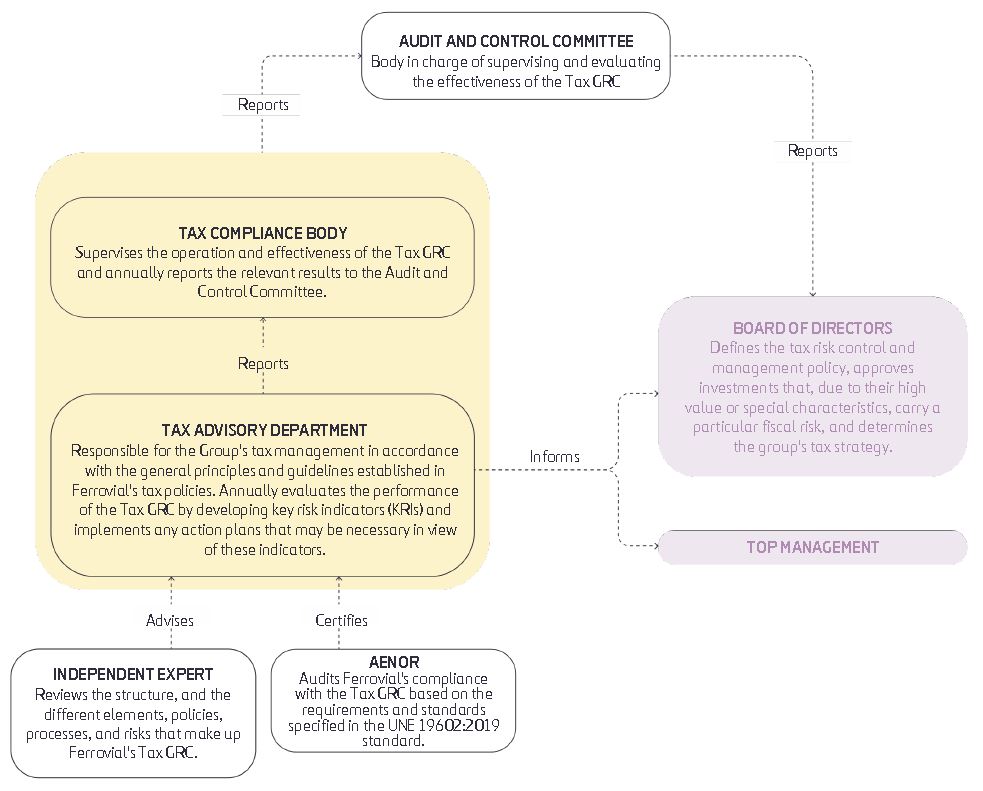
FERROVIAL’S TAX GOVERNANCE, RISK AND COMPLIANCE SYSTEM (TAX GRC)
The role of the Board of Directors
Prior to the preparation of the annual financial statements and the filing of the corporate income tax return, the Board is informed of the tax policies applied during the financial year and their degree of compliance. It is also informed of the conclusions arising from the supervision and evaluation of the operation and effectiveness of such policies, which are reported in the Annual Corporate Governance Report.
In the case of transactions or matters to be submitted to the Board of Directors for approval, the Board of Directors is informed in advance of the relevant tax consequences of such transactions or matters.
The role of Ferrovial’s Compliance Department and Risk Department
In 2025, Ferrovial’s Compliance Department, together with the Risk Department, coordinated by the Tax Advisory Department, acted as the Tax Compliance Body.
Under the supervision of the Control and Audit Committee (CAC), this Body is responsible for reviewing the TAX GRC, analyzing the performance system, managing complaints, and providing ongoing training, in accordance with its Operating Rules.
The role of the Tax Advisory Department
The Tax Advisory Department is a centralized body with financial autonomy made up of experienced tax experts whose main objective is to manage the Group’s taxes in accordance with Ferrovial’s general principles and tax policies.
Since 2017, it has submitted on a voluntary basis an annual Tax Transparency Report to the Spanish Tax Administration, which has strengthened legal certainty, mutual understanding, and reciprocal trust with the Spanish tax authorities.
TAX RISK PREVENTION AND MANAGEMENT
The main objective of Ferrovial’s Tax Governance, Risk and Compliance System (“TAX GRC”) is to establish a tax governance framework that ensures that the Company’s actions and operations are governed by clear principles, values, and rules, in line with the Code of Ethics and Business Conduct and other corporate governance standards. This allows any employee, person, or entity within the Company to make the appropriate decisions as regards compliance with tax legislation.
This due diligence framework is subject to ongoing monitoring and control procedures in order to ensure strict compliance with applicable laws and the adoption of the highest ethical standards in the development of the Company’s activities. The management and analysis of the operation of this system is the responsibility of the Tax Advisory Department.
Minimum taxation of multinational groups (Pillar Two)
Pillar Two is an international regulatory framework aimed at ensuring that the global profits of multinational groups are subject to a tax rate of no less than 15% in each jurisdiction in which they operate. The rules were designed by the OECD Inclusive Framework and subsequently incorporated into EU law through EU Council Directive 2022/2523 of December 14, 2022. In the Netherlands, the Minimum Tax Rate Act 2024, based on the EU Directive, is applicable to financial years beginning on or after December 31, 2023.
Under Pillar Two rules, if in certain jurisdictions where Ferrovial operates the effective tax rate (given by the ratio between adjusted accounting profit and adjusted corporate income tax paid in that jurisdiction) falls below 15%, then Ferrovial must pay an additional tax (the so-called top-up tax) to reach the 15% corporate income tax threshold.
Ferrovial estimated its potential exposure to Pillar Two for the 2025 financial year based on the financial statements at the end of the financial year, concluding that no top-up tax arises in any of the jurisdictions in which it operates.
Tax havens
Ferrovial does not conduct operations in any jurisdiction considered a tax haven by the Dutch Tax Administration, nor in any country or territory designated as non-cooperative in tax matters by the European Union.
Certification of the Tax Governance, Risk and Compliance System (“TAX GRC”)
In February 2021, Ferrovial’s Tax Governance, Risk and Compliance System (“TAX GRC”) was certified by AENOR, in accordance with the UNE 19602 standard. This certification endorses Ferrovial’s commitment to regulatory compliance, responding to the regulatory requirements of markets, customers, shareholders, investors, and other stakeholders. The certification also reflects the Company’s high ethical standards and its commitment to best corporate governance practices.
In February 2024, following the 2023 audit process, AENOR verified that the system complies with the requirements of the standard and with the audit criteria, thus granting the renewal of the certification for a period of three years, from 2024 to 2026.
Also, in February 2026, the system was reviewed by AENOR in relation to the 2025 financial year, concluding that it remains effectively implemented and complies with the requirements of the standard and with the audit criteria in that period.
Tax Corner
Ferrovial has reinforced its commitment to tax transparency by adding a new section to its corporate website: Tax Corner – Ferrovial. This section is designed to provide accessible, timely, and relevant information on the Group’s taxation to all interested stakeholders. The section includes details on Ferrovial’s tax management model, total tax contributions by market, country-by-country reporting data, as well as information on tax litigation and other aspects of interest.
Finally, as in previous years, the following details are provided: tax-contributions by market for the 2025 and 2024 financial years, the Country-by-Country Report data for the 2024 financial year, and the reconciliation-of the statutory and effective rate by jurisdiction in the 2024 financial year.
TAX CONTRIBUTION BY MARKET – 2025 and 2024
The following tables summarize the amounts paid by Ferrovial in 2025 and 2024 expressed in millions of euros, respectively. These figures are aggregated based on the percentage of ownership of the assets. The main assets consolidated using the equity method in 2025 are the 407 ETR in Canada (48.29%), JFK NTO in the United States (49%), IRB in India (23.99%) and Heathrow in UK (5.25%).
| Market | Paid Taxes¹ | Collected Taxes² | TOTAL (€M) 2025 | TOTAL (€M) 2024 | |
| Corporate tax | Rest | ||||
| Netherlands | 0 € | 3 € | 37 € | 40 € | 9 € |
| Spain | 1 € | 95 € | 85 € | 180 € | 244 € |
| United Kingdom | 6 € | 53 € | 88 € | 147 € | 227 € |
| Poland | 25 € | 27 € | 99 € | 151 € | 136 € |
| United States | 7 € | 33 € | 91 € | 130 € | 118 € |
| Canada | 90 € | 12 € | 44 € | 146 € | 218 € |
| Chile | 7 € | 1 € | 38 € | 45 € | 68 € |
| Australia | 13 € | 2 € | 10 € | 24 € | 24 € |
| India | 18 € | 0 € | 2 € | 21 € | 19 € |
| Rest of Europe, America & Others³ | 10 € | 16 € | 39 € | 65 € | 46 € |
| TOTAL 2025 | 176 € | 242 € | 532 € | 950 € | 1,109 € |
| TOTAL 2024 | 136 € | 435 € | 538 € | 1,109 € | |
1Taxes paid by Ferrovial arising from its activity and operations, which represent a direct cost (e.g. corporate income tax, non-deductible VAT, local taxes, etc.).
2Taxes collected by Ferrovial and paid to public finances on behalf of third parties (e.g. labor tax (employees), net VAT, withholdings, etc.).
3Includes Brazil, Czech Republic, Colombia, France, Germany, Greece, Ireland, Italy, Luxembourg, New Zealand, Oman, Peru, Portugal, Puerto Rico, Saudi Arabia, Slovakia, Turkey.
TAXATION: COUNTRY-BY-COUNTRY REPORT
The following table reflects the data reported to the Dutch Tax Authorities through the Country-by-Country Report for the 2024 financial year (in € million).
Data corresponding to 2024 are published, rather than those for 2025, in accordance with the obligation to report the Country-by-Country Report to the Dutch Tax Authorities in December of each year with respect to the previous year’s data.
In any case, before December 31, 2026, the Group will publish the Country-by-Country Report for the 2025 financial year on its website, in accordance with the implementation in the Netherlands of Directive (EU) 2021/2101 of the European Parliament and of the Council of November 24, 2021, amending Directive 2013/34/EU with respect to the disclosure of information relating to corporate income tax by certain companies and branches.
| 2024 (€M) | ||||||||||
| Jurisdiction¹ | Number of employees² | Third Party Revenues | Income Related Entity | Total Revenues³ | Profit before income tax³ | Income tax (paid)³ | Income tax (accrued)³ | Capital³ | Undistributed results³ | Tangible assets³ |
| Argentina | 0 | 0 | 0 | 0 | 0 | 0 | 0 | 0 | 0 | 0 |
| Australia | 185 | 368.03 | 1.81 | 369.84 | 53.02 | 10.76 | 17.82 | 118.05 | -67.75 | 3.34 |
| Bolivia | 0 | 0 | 0 | 0 | 0 | 0 | 0 | 0.01 | 0 | 0 |
| Brazil | 1 | 0.31 | 0 | 0.31 | 0.27 | 0.06 | 0.07 | 8.29 | -6.91 | 0 |
| Canada | 655 | 605.15 | 10.70 | 615.86 | 367.35 | 11.28 | 7.96 | 119.88 | 408.30 | 69.79 |
| Chile | 4,479 | 387.15 | 15.39 | 402.54 | -3.84 | 1.03 | 5.10 | 315.76 | 100.59 | 206.62 |
| Colombia | 181 | 23.72 | 17.16 | 40.87 | 15.30 | 3.59 | 3.39 | 1.63 | 34.32 | 1.52 |
| Czech Republic | 0 | 16.79 | 0 | 16.79 | -10.40 | 0 | 0 | 0.07 | -10.47 | 1.79 |
| Germany | 799 | 78.67 | 2.24 | 80.91 | -0.50 | 1.34 | 1.61 | 15.94 | -5.75 | 2.85 |
| Spain | 5,934 | 1,681.51 | 719.05 | 2,400.56 | 127.21 | -4.88 | 20.87 | 532.69 | 751.49 | 688.79 |
| France | 43 | 67.26 | 2.76 | 70.02 | 2.87 | 0.99 | 1.85 | 13.01 | -0.66 | 11.06 |
| United Kingdom | 1,169 | 846.15 | 103.23 | 949.38 | 23.74 | 2.03 | 1.73 | 268.20 | 57.17 | 114.39 |
| Greece | 0 | 0 | 0 | 0 | -0.07 | 0 | 0 | 0 | 0 | 0.01 |
| Ireland | 2 | 2.02 | 0.76 | 2.78 | 2.06 | 0.54 | 0.60 | 107.74 | -99.43 | 0 |
| India | 6 | 0.99 | 0 | 0.99 | -0.66 | 0 | 0 | 0.02 | -1.10 | 0 |
| Italy | 2 | 0.06 | 0 | 0.06 | -0.02 | 0 | 0 | 0 | 0 | 0 |
| Luxembourg | 0 | 4.81 | 0.29 | 5.11 | 3.65 | 0.01 | 0.91 | 4.00 | 16.94 | 0 |
| Latvia | 0 | 3.39 | 0 | 3.39 | -1.68 | 0 | 0.01 | 0 | -1.70 | 0.21 |
| Mexico | 0 | 0 | 0 | 0 | 0 | 0 | 0 | 0.00 | -0.32 | 0 |
| Netherlands | 23 | 1,795.83 | 184.77 | 1,980.60 | 1,499.94 | 11.78 | 16.32 | 1,506.03 | 17,459.06 | 0.91 |
| New Zealand | 0 | 0.12 | 0 | 0.12 | 0.10 | 0 | 0 | 2.85 | -1.37 | 0.82 |
| Oman | 0 | 0.12 | 0 | 0.12 | -0.19 | 0.37 | 0 | 0 | 0 | 0.00 |
| Peru | 14 | 32.30 | 0.38 | 32.68 | -0.15 | 0.85 | 1.18 | 0.05 | -0.12 | 0.23 |
| Poland | 6,702 | 2,065.43 | 52.54 | 2,117.98 | 199.08 | 49.87 | 32.28 | 173.40 | 176.90 | 363.16 |
| Puerto Rico | 250 | 77.41 | 1.79 | 79.21 | 2.61 | 0.28 | 0.69 | 19.43 | 9.48 | 4.06 |
| Portugal | 116 | 113.00 | 2.14 | 115.14 | 5.45 | 0.95 | 2.59 | 0.05 | 2.09 | 2.05 |
| Saudi Arabia | 3 | 0.30 | 0.01 | 0.30 | -0.15 | 0 | 0 | 23.92 | -20.67 | 0 |
| Slovakia | 6 | 39.83 | 1.24 | 41.07 | -26.67 | 0.94 | 0.04 | 78.37 | -93.64 | 0.79 |
| Turkey | 184 | 86.43 | 0 | 86.43 | 31.07 | 0 | 0 | 92.01 | 2.98 | 526.17 |
| Dominican Republic | 0 | 0 | 0 | 0 | 0.00 | 0 | 0 | 0 | 0 | 0 |
| Tunisia | 1 | 0 | 0 | 0 | -0.03 | 0 | 0 | 0 | 0 | 0 |
| United States | 4,746 | 2,871.73 | 785.81 | 3,657.54 | 603.61 | 2.37 | 6.70 | 12,061.30 | 4,313.28 | 5,810.59 |
| Uruguay | 0 | 0 | 0 | 0 | 0 | 0 | 0 | 0.05 | 0 | 0 |
| Total | 25,501 | 11,168.51 | 1,902.07 | 13,070.58 | 2,893.00 | 94.15 | 121.72 | 15,462.73 | 23,022.71 | 7,809.14 |
1The Consolidated Financial Statements for the 2025 financial year, Appendix I, include those entities that make up the business group, their residence, and the activities they carry out.
2Regarding number of employees, an approximate calculation was made of the total number of employees on a full-time equivalent basis.
3Regarding income, results, and taxes in foreign currency, the average exchange rate for the financial year is used; regarding tangible assets, the closing exchange rate for the financial year is used.
INCOME TAX: STATUTORY VS. EFFECTIVE CORPORATE TAX RATE BY JURISDICTION
The following table provides a qualitative explanation of the differences between the statutory and effective tax rates for the jurisdictions in which Ferrovial accrued corporate income tax in 2024. As the data is extracted from the Country by Country report, the table only reflects the current corporate income tax accrued by companies that are fully consolidated with Ferrovial SE.
EFFECTIVE RATE 2024
| 2024 | ||||
|---|---|---|---|---|
| Corporate income tax | ||||
| Jurisdiction | Statutory Rate | Effective Rate | Difference | Explanation |
| Germany* | 30.00% | N/A | N/A | Some companies report profits and are taxed on the amount accrued, and others incur losses and therefore do not recognize the current tax expense. These profits and losses are not offset, as the entities are not consolidated for tax purposes. |
| Saudi Arabia | 20.00% | 0.00% | 20.00% | Country in which no activities were conducted. |
| Australia | 30.00% | 34.00% | -4.00% | The effective rate is higher than the statutory rate due to positive temporary adjustments that increase the taxable base. |
| Brazil | 34.00% | 27.00% | 7.00% | The rate is lower because one of the companies applies losses up to the compensation limit (30%). |
| Canada | 26.50% | 2.00% | 24.00% | The effective tax rate is lower than the statutory rate mainly due to the inclusion of exempt dividend income in the tax base. Excluding this effect, the effective tax rate would be still lower than the statutory rate (approx. 19%), as certain entities recognize taxable profits while others incur losses without recording current tax expense, and these amounts are not offset because the entities are not subject to tax consolidation. |
| Chile* | 27.00% | N/A | N/A | Some entities generate taxable profits and therefore incur current tax expense, while others report losses and do not recognize current tax expense. These amounts are not offset because the entities are not consolidated for tax purposes. |
| Colombia | 35.00% | 22.00% | 13.00% | Some entities generate taxable profits and therefore incur current tax expense, while others report losses and do not recognize current tax expense. These amounts are not offset because the entities are not consolidated for tax purposes. |
| Slovakia | 21.00% | 0.00% | 21.00% | Given that losses were incurred during the period, no current income tax expense has been recognised. |
| Spain | 25.00% | 16.00% | 9.00% | The effective tax rate is lower than the statutory rate mainly for the limitation on the use of the applicable tax loss carry forwards and deductions. |
| United States | 21.00% | 1.00% | 20.00% | Current tax is recognised in respect of state taxes. No federal current tax expense is recognised as the consolidated tax group generated tax loss carryforwards during the period. |
| France | 25.00% | 64.00% | -39.00% | The effective rate is higher than the statutory rate due to positive temporary adjustments that increase the tax accrued. |
| Netherlands | 25.80% | 1.00% | 25.00% | No tax expense is accrued for the generation of losses in the consolidated tax group. The current tax expense recorded corresponds to withholdings paid abroad. |
| India | 30.00% | 0.00% | 30.00% | The effective rate is lower than the statutory rate due to the generation of losses. |
| Ireland | 25.00% | 29.00% | -4.00% | Effective and statutory rates are aligned. |
| Luxembourg | 25.00% | 25.00% | 0.00% | Effective and statutory rates are aligned. |
| Oman | 15.00% | 0.00% | 15.00% | Country in which no activities were conducted |
| Peru* | 29.50% | N/A | N/A | Consortiums in Peru are taxed separately from their parent company for corporate income tax purposes. The accrued expense corresponds to the consortiums with a positive taxable base, while the branches have tax losses that cannot be offset. |
| Poland | 19.00% | 16.00% | 3.00% | Effective and statutory rates are aligned. |
| Portugal | 22.50% | 48.00% | -25.00% | The effective tax rate is higher than the statutory rate due to taxable base adjustments and limitations on the utilisation of tax losses. |
| Puerto Rico | 29.00% | 26.00% | 3.00% | Effective and statutory rates are aligned. |
| United Kingdom | 25.00% | 7.00% | 18.00% | The effective rate is lower than the statutory rate because tax losses from previous years were used to offset the positive taxable income generated in the year up to the limitation of use. |
| Czech Republic | 21.00% | 0.00% | 21.00% | The effective rate is lower than the statutory rate due to the generation of losses. |
| Turkey | 25.00% | 0.00% | 25.00% | The effective rate is lower than the statutory rate due to the generation of tax losses. |
* The effective tax rate derived from the aggregation is not representative of the Group’s tax position.

MEMBERSHIPS AND COLLABORATIONS
Characterized by political neutrality, the Company carries out its activities for both public administration and private clients in the countries where it operates.
Ferrovial has a Lobbying and Political Contributions Policy in place, the purpose of which is to establish the standards for constructive political engagement by Ferrovial employees, officers and directors and to provide a framework to ensure that Ferrovial, its directors and employees, and outside lobbyists comply with all applicable laws, rules and regulations related to lobbying and political contributions.
Ferrovial’s business depends to a significant extent on relationships with the governments of the countries in which it operates. Accordingly, Ferrovial undertakes to maintain open and honest communication with its government partners. Employees who interact with governments on behalf of Ferrovial must ensure that all communications, both direct and through intermediaries, are accurate and comply with applicable laws and regulations, including those related to lobbying and anti-corruption matters. Lobbyists are required to follow the process outlined in the Ferrovial Due Diligence Policy for the Integrity of Third Parties and, where applicable, the relevant lobbying registration requirements must be met. Ferrovial is a member of business representation organizations and foundations that promote trade and cooperation between countries linked to the development of its activities or the geographic areas in which it operates. Through its participation and collaboration with these organizations, the Company seeks to contribute to the progress and development of all those fields in which it is present.
Notable contributions to both include those made to Associated General Contractors, American Council of Engineering Companies (ACEC), Airports Council International, American Road&Transportation Builders Association (ARTBA), Texas Water Infrastructure Network, American Concrete Pavement Association, Association of Construction Companies and Infrastructure Concessionaires (SEOPAN)and World Economic Forum.
Ferrovial’s Lobbying and Political Contributions Policy prohibits the use of corporate funds to make contributions to political parties, political committees or candidates, even where permitted by law—except in the United States, where Ferrovial may make such contributions at state and local levels, always within the limits established by applicable law. In these cases, all decisions regarding any such contributions must be made by US citizens or permanent residents (Political Contributions Using Corporate Funds, State/Regional/Local are allowed, depending on the jurisdiction; likewise, Political Contributions Using Employee Funds (Political Action Committee (PAC) are allowed.
| 2023 | 2024 | 2025 | |
| Contributions to political parties or candidates (€) | 0 | 0 | 0 |
| Lobbying activities or sector associations (€) | 1,515,894 | 1,500,322 | 1,719,594 |
| Trade Associations (€) | 151,134 | 185,194 | 408,051 |
| Total contribution (€) | 1,667,028 | 1,685,516 | 2,127,645 |
The Company does not make in-kind contributions to political parties or electoral candidates.
Ferrovial maintains a strong commitment to corporate responsibility and sustainability, actively participating in organizations that promote Corporate Responsibility. It is a member of SERES Foundation, Forética, the Spanish Network of the United Nations Global Compact and the Spanish Association for Quality (AEC). It also collaborates with other organizations that promote sustainability in different areas, including the Green Building Council (GBCe), the Circular Economy Pact, the EU Green Growth Group, We Mean Business, and the European Climate Pact.