
SOCIAL INFORMATION
ESRS S3 AFFECTED COMMUNITIES
SBM-3: MATERIAL IMPACTS, RISKS AND OPPORTUNITIES AND THEIR INTERACTION WITH STRATEGY AND BUSINESS MODEL
| Affected communities | Stage* | Description | Likelihood of occurrence | Time horizon |
|---|---|---|---|---|
| Communities’ economic, social and cultural rights; Rights of indigenous peoples | ||||
| (+) Impact | OP, C | Reduction of inequalities and improvement of the situation of vulnerable communities by means of the development and promotion of social action projects, research, education, the fight against hunger, etc. | Current | S |
| (+) Impact | OP, C | Improvement in the living conditions of local communities resulting from Ferrovial’s infrastructure assets (reduction of accidents, greater predictability of travel times, reduced urban congestion, access to drinking water or better urbanized areas). | Current | S |
| (-) Impact | OP, VC | The construction and development of infrastructure, such as roads, bridges, dams, energy, drinking water and transport systems can directly affect the human rights of communities and clients (displacement of population, for example). | Current | M |
| Risk | OP, VC | Reputational damage and loss of trust as a responsible company that does not comply with human rights. | M | |
| Opportunity | OP, VC | Differentiation and access to customers with solid human rights standards. | S | |
| Other | ||||
| (-) Impact | OP, Pt, C | Discomfort caused to the local community due to construction and operational activities (noise pollution, road closures, etc.). | Current | S |
| (+) Impact | OP, C | Promotion of local sourcing by integrating the entire value chain. | Current | S |
| (+) Impact | OP, Pu | Wealth and employment generation in the communities in which the Company operates through a local purchasing policy. |
Current | S |
| Opportunity | OP, C | Enhancement of the Company’s reputation and corporate image, and consolidation in local markets | M | |
| Opportunity | OP, C | Strengthening the license to operate due to good management with local communities. | M | |
| Opportunity | OP, C | Increased employee pride of belonging and engagement, as well as improved talent attraction, driven by participation in social projects and the Company’s demonstrated commitment. | M | |
* OP: Own operations; VC: Value chain; Pu: Purchases; C: Customers; Pt: Partners; S: Short term; M: Medium term; L: Long term.
S3-1: POLICIES RELATED TO AFFECTED COMMUNITIES
Ferrovial has a Human Rights Policy (see Human Rights Policy table) in which addresses the management of its impacts, risks, and opportunities related to affected communities. Likewise, Ferrovial ensures compliance with local laws and respect for the rights, culture, customs, and values of people in local communities and minorities potentially affected by its activities, paying special attention to vulnerable populations, such as immigrants. In order to ensure respect for the rights of those communities that may be affected by Ferrovial’s activities and to strengthen the due diligence process carried out by Ferrovial in order to identify, prevent, or mitigate any risks associated with local or affected communities, in 2025 Ferrovial approved a procedure aimed at governing engagement with local communities that standardizes the information available on relations with local communities in the different projects carried out by the Company and the infrastructure it manages.
The procedure establishes as a first step the analysis of the relevant affected communities by the project or work, and the creation of a map of stakeholders, defining their specific characteristics, paying special attention to those groups that may be more vulnerable or exposed to a greater risk of harm or to marginalized neighborhoods, with special mention if there are indigenous peoples among the affected communities. Factors such as social, economic, or environmental vulnerability are also taken into account to prioritize the appropriate mitigation actions and to promote the wellbeing of these communities.
In addition to the existing corporate channels described in the Stakeholder Engagement and Relationship Policy, the Company has, either directly or through the asset owner, the necessary channels to facilitate dialogue with affected communities so that they can raise their concerns and questions, or express needs. These channels include reporting mechanisms, hotlines, meetings, or other means that may be relevant to the project. The Company undertakes to take the necessary steps to make these channels known to the affected communities so that they are accessible and to ensure that dialogue is established through legitimate and credible representatives. Ferrovial assesses whether there is any material impact on the human rights of the affected community. If any material risk to any group within the affected community is identified, it will be made public along with the mitigation and remediation measures adopted.
As a result of the dialogue with affected communities and local authorities, those incidents and inconveniences that may arise from the execution of the project or work are identified. The Company will report these incidents and adopt the necessary measures to minimize their impact, establish objectives, and monitor them and the results achieved in coordination with stakeholders.
The proposed procedure takes a step toward greater transparency by providing a common model for collecting all this information for publication.
The Company also contributes to the development of social projects that support these communities, thereby ensuring responsible and sustainable management of its impact on the environment. This integration of policies ensures that Ferrovial addresses community-related challenges in a consistent and effective manner, in line with its commitments to respect and promote human rights.
Ferrovial is also committed to minimizing the environmental impact of its operations on those communities that may be affected, following a preventive approach that responds to current environmental challenges, such as the proper management of water resources and the supply of sustainable products.
Furthermore, Ferrovial aligns its human rights commitments with the United Nations Guiding Principles on Business and Human Rights, ensuring that its activities respect and uphold these principles throughout its value chain. The Company integrates human rights due diligence processes to identify, prevent, and mitigate potential adverse impacts on affected communities.
Ferrovial also has grievance mechanisms in place so that stakeholders can report their concerns regarding human rights violations. To date, no cases of non-compliance with the United Nations Guiding Principles have been reported in relation to Ferrovial’s activities. However, the Company remains vigilant and continuously monitors its operations to ensure compliance with international standards and best practices for the protection of human rights.
To reinforce this commitment, the procedure for relations with local communities that is currently being developed pays special attention to preventing any impact on indigenous, tribal, and native peoples.
During financial years 2024 and 2025, no cases of violation of indigenous peoples’ rights were detected.
| Policy | Engagement and Relations with Stakeholders Policy |
| Description | Transparency and disclosure of information by Ferrovial as a listed entity to all its stakeholders is a fundamental obligation. The Board of Directors of Ferrovial will take the necessary measures to disseminate relevant information about the Company and its group entities to shareholders and the investor community in an effective and timely manner. |
| Objective | This policy aims to establish the principles governing communication and contact with shareholders, investors, proxy advisors, credit rating agencies, other stakeholder (including local communities) and the market in general; to define the communication channels available to these parties; and to outline the overall corporate, financial, and non-financial communication strategy through the Company’s information channels. |
| Associated material Impacts, risks and opportunities |
|
| Follow-up and remediation process | The Company will periodically identify the interests of relevant stakeholders and determine on a case-by-case basis who these stakeholders are. Ferrovial applies a systematic approach to engaging with stakeholders, including periodical surveys and responding to ESG analysts’ questionnaires. |
| Scope of the policy | |
| Affected stakeholders | This policy applies to all Ferrovial Group entities, regardless of their business area, geographic location, or activities.
Stakeholders: employees, customers, suppliers, competitors and partners, shareholders, investors, analysts, local communities affected by Ferrovial’s activities. |
| Geographic areas | Global |
| Value chain application | Ferrovial adapts its communication channels and initiatives to the specific characteristics of each stakeholder group, ensuring effective engagement and the dissemination of information throughout the value chain. |
| Exclusions from the application | None specified. |
| Policy approval flow | |
| Responsible party | Board of Directors – responsible for approving the policy.
The General Economic and Financial Directorate, the Communications Directorate, and the General Secretariat shall ensure that the Company complies, within the scope of their respective competences, with current legislation in the application of this Policy. |
| Other Issues to report (if applicable) | |
| Consistency with third-party Instruments or standards | This policy complies with the provisions of the Dutch Corporate Governance Code on stakeholder dialogue and shareholder engagement. |
| Stakeholder engagement | Ferrovial ensures continuous and permanent information through effective communication channels, leveraging new technologies and maintaining cooperation and transparency with the competent authorities and regulators. |
| How it is made available | This policy is available on the Ferrovial website (ferrovial.com) and on the intranet. |
| Significant policy changes | N/A – no changes have been made. |
S3-2: PROCESSES FOR ENGAGING WITH AFFECTED COMMUNITIES ABOUT IMPACTS
General collaboration with affected communities
Ferrovial has systematic processes in place to interact with affected communities or their representatives. This includes the implementation of environmental impact studies prior to the start of projects and the establishment of specific communication channels for each project. These channels collect suggestions, complaints, or reports from affected groups and enable a two-way dialogue that begins before the construction phases and continues throughout the project’s life cycle.
Stakeholder perspectives on impact management
a. Direct collaboration: Ferrovial establishes dialogue with local communities, their legitimate representatives, or credible In particular, specific channels are created for each project to facilitate communication with affected communities. In addition, biannual consultation as part of the materiality study ensures that the perspectives of all stakeholders are included.
b. Phases and types of collaboration: Interaction takes place throughout all phases of the project, beginning before The frequency and type of communication depend on the characteristics of each project. Collaboration includes public consultations, briefings and gathering community input through accessible channels.
c. Responsible function: Operational responsibility for ensuring that these interactions take place lies with the local teams at each site, supported by the Sustainability Department and the Compliance The latter reports regularly to senior management on the results and any necessary improvements.
d. Efficiency assessment: Ferrovial uses the internationally recognized B4SI methodology to measure the impact of its actions on the community.
The B4SI (Business for Societal Impact) methodology is an internationally recognized standard that provides a structured framework for measuring and managing a company’s contributions to society. It classifies corporate contributions by breaking them down into community investments, charitable donations, and business initiatives with social impact, each with specific indicators to assess their impact. This methodology promotes transparency, comparability, and strategic alignment with business objectives, enhancing a company’s reputation for measurable social impact.
In addition, each construction projects and concessions monitor and document all dialogue-related actions carried out with the communities
Measures for vulnerable and marginalized groups
Ferrovial focuses on inclusive development through social programs aimed at vulnerable groups. Initiatives include:
- Basic infrastructure: Access to drinking water, food, and health services.
- Education: Promotion of STEM vocations with an emphasis on girls and disadvantaged communities.
- Social emergencies: Responding to humanitarian crises and other projects in nearby
- Projects in collaboration with employees.
The procedure prioritizes the identification of vulnerable communities in project areas and the adoption of measures to maximize positive effects on them.
Respect for the rights of indigenous peoples
Ferrovial respects and recognizes the rights of indigenous, tribal, and native peoples in accordance with current legislation and ILO Conventions 107 and 169. Although no activities involving these peoples has been identified in recent years, Ferrovial has defined a procedure for relations with local communities that pays special attention to indigenous peoples. The Company prevents any negative impact on their cultural, territorial, religious, and intellectual rights in accordance with the OECD Guidelines for Multinational Enterprises.
These measures include:
- Cultural sensitivity training: Providing training to employees and contractors to ensure they understand and respect the cultural practices and traditions of indigenous communities.
- Consultation and consent: Engaging in meaningful consultations with indigenous communities to obtain their free, prior, and informed consent before initiating any project that may affect their lands or rights.
- Impact assessments: Conducting thorough social and environmental impact assessments to identify potential risks to indigenous rights and implementing mitigation strategies to address these risks.
- Monitoring and reporting: Establishing mechanisms for ongoing monitoring and reporting on the impact of projects on indigenous communities to ensure compliance with human rights standards.
- Grievance mechanisms: Providing accessible and effective grievance mechanisms so that indigenous communities can raise their concerns and seek redress for any negative impacts.
In future projects, Ferrovial is committed to respecting the right to free, prior, and informed consultation of these peoples in activities that may affect their lands, territories, or cultural assets as well as with regard to legislative or administrative measures that may directly affect them.
S3-3: PROCESSES TO REMEDIATE NEGATIVE IMPACTS AND CHANNELS FOR AFFECTED COMMUNITIES TO RAISE CONCERNS
Ferrovial maintains a strong commitment to its stakeholders, establishing effective communication channels and procedures to remediate any adverse impacts resulting from its activities. This approach ensures that affected communities can raise their concerns and that the Company responds in a transparent and responsible manner.
Communication channels with affected communities
Ferrovial has multiple channels tailored to the needs of local communities and the specific characteristics of each project. These include:
- Ethics Channel: A confidential and accessible means for employees and stakeholders to safely report concerns, complaints, or incidents.
- Website and Corporate Mailboxes: They provide access to information and direct contact with the Company.
- Social Media: Ferrovial uses platforms such as X (formerly Twitter), Facebook, LinkedIn, Instagram, and others to disseminate information of interest and encourage dialogue with different audiences.
- Project-Specific Channels: Each project or concession establishes specific means, such as hotlines, community meetings, and grievance mechanisms, ensuring that they are accessible and tailored to local needs.
The Company takes steps to ensure that communities know these channels, using tools such as posters, briefings, and social media. It also ensures that representatives of affected communities are legitimate and trustworthy, facilitating transparent dialogue. To further build trust, Ferrovial engages in continuous and proactive communication with community members, ensuring they are duly informed about the channels available to raise their concerns, providing specific channels at each site and assets for communication with local communities. The Company also conducts regular surveys and feedback sessions to measure the effectiveness of these channels and understand the community’s perception of their reliability.
Impact remediation and effectiveness evaluation:
If material adverse effects are identified, Ferrovial applies a structured approach to remediate them. This includes:
- Incident identification: Through the aforementioned channels, the Company receives and manages concerns related to disturbances such as noise, dust, or traffic disruptions.
- Corrective measures: In coordination with the affected communities and local authorities, targeted actions are carried out to mitigate the impacts.
- Monitoring and evaluation: The effectiveness of the measures is evaluated periodically, ensuring that the solutions are adequate and generate positive results.
Ferrovial tracks and monitors issues raised through its grievance mechanisms and community participation processes. These channels are designed to be accessible and responsive, enabling problems to be identified and resolved in a timely manner. The Company uses key performance indicators (KPIs) to measure the effectiveness of its responses and the satisfaction of the communities affected. In addition, regular audits and reviews are conducted to ensure compliance with human rights standards and identify areas for improvement.
The Ferrovial procedure for engaging with local communities standardizes public information about these incidents and the measures adopted, promoting transparency and continuous improvement. This procedure includes detailed reports on the nature of the incidents, the measures taken to remediate them, and the results obtained. By maintaining open communication and regularly informing stakeholders, Ferrovial ensures that its channels for addressing community concerns are effective and trustworthy. In addition, the Ethics Channel guarantees anonymity to protect whistleblowers against retaliation for using these channels to raise concerns or needs.
Supporting channel availability in business relationships
The Company also ensures the availability of these channels through its business relationships. This includes:
- Collaboration with asset owners: In projects operated by third parties, Ferrovial works to ensure that the appropriate means are established to facilitate dialogue with communities.
- Proactive coordination: Incidents are identified and addressed in real time, promoting fluid communication with all stakeholders.
- Information disclosure: Ferrovial uses tools such as social media, meetings, and other means to inform communities of the existence of these channels.
- Examples of decisions based on stakeholder perspectives: Ferrovial’s commitment to communities is reflected in targeted actions taken in response to their concerns.
- Local impact management: In infrastructure projects, a two-way dialogue is promoted before construction begins, ensuring that community voices are heard during every phase of the project.
- Tailored solutions: Measures implemented to mitigate nuisances such as noise and traffic are designed in collaboration with communities, ensuring that they respond to their specific needs.
S3-4: TAKING ACTION ON MATERIAL IMPACTS ON AFFECTED COMMUNITIES, AND APPROACHES TO MANAGING MATERIAL RISKS AND PURSUING MATERIAL OPPORTUNITIES RELATED TO AFFECTED COMMUNITIES, AND EFFECTIVENESS OF THOSE ACTIONS
Ferrovial establishes measures to manage impacts on local communities and promote positive effects in them. The Company conducts environmental and social impact studies prior to project execution, ensuring a two-way dialogue with affected communities to communicate potential implications and gather suggestions through channels such as the Ethics Channel. Through its social programs, Ferrovial conceives the investment in the community as a strategic instrument for the development of society and the environment in which it operates.
The Company has established a human rights due diligence procedure to analyze potential risks and prevent undesirable impacts. All internal procedures and policies are global in scope. Environmental impact assessments are carried out before a project begins, as is the go/no go decision process. Risk assessments for each project or asset are carried out every six months and reported to senior management.
The Ferrovial Procedure for engaging with affected communities includes remediation measures aimed at mitigating unwanted effects on communities, such as noise and dust. For more details, please refer to the attached procedures. This type of information arises during the risk analysis carried out every six months and is specific to each project or asset managed.
Financial information related to these actions is included in project budgets but is not itemized separately. No additional data is currently available on the allocation of financial resources to these initiatives.
The procedure seeks to strengthen the human rights due diligence process in communities that may be impacted by Ferrovial’s activities by creating an action plan that follows these steps:
- First, the affected communities are identified in all Ferrovial projects with a scope greater than €50 million, or any project that has given rise to a material social risk. Once the stakeholders have been identified through a mapping process that identifies their specific characteristics, particular emphasis is applied to those who are most vulnerable, as well as to indigenous groups.
- Ferrovial then establishes the necessary channels to engage in the appropriate dialogue with the affected communities, enabling them to raise their uncertainties, doubts, or needs.
- Once the impacts and/or needs are identified, Ferrovial will take three actions:
- Assess whether there are any significant impacts related to the human rights of the affected communities If identified, they will be made public and the necessary measures will be taken to mitigate or remediate the impact.
- As a result of the dialogue with the affected communities and local authorities, possible incidents or disturbances will be identified and the necessary measures will be established to minimize the corresponding impacts, establishing targets and reviewing progress and results. The coordination of the entire process will be carried out in collaboration with stakeholders.
- Ferrovial is also committed to generating a positive impact in the communities where it operates. The Company undertakes to analyze and identify potential opportunities. Whenever possible, Ferrovial will adopt measures that complement activities in the areas concerned in order to increase the benefits for the affected communities.
The Project Manager or asset manager will be responsible for compiling the information identified above to facilitate the monitoring of the measures adopted, in accordance with the time frame established for each project based on its particular needs. The information compiled will be forwarded to the Communications and CSR departments. Ferrovial undertakes to share information about this procedure on its website and through any other channels deemed necessary.
In addition to these measures, Ferrovial addresses material incidents, risks, and opportunities related to local communities through a set of structured actions aimed at mitigating negative impacts and promoting positive ones. These actions include:
- Community engagement plans: Developing and implementing comprehensive plans that outline how the Company will engage with local communities throughout the project lifecycle, ensuring that their concerns are addressed.
- Risk management: Identifying and assessing potential risks to communities in the early stages of project planning and integrating risk management strategies to prevent adverse Specific risks, such as noise or traffic disruption during construction, are managed with tailored mitigation measures, such as adjusting work schedules or clearly notifications about traffic cuts.
- Capacity building: Investing in initiatives that improve the resilience and self-sufficiency of local communities, including training programs, employment opportunities, and access to critical resources such as water and education.
- Independent audits: Conducting independent audits and assessments to verify compliance with human rights standards and ensure the effective implementation of mitigation measures.
Ferrovial established a global community investment strategy under the “On the Move for People” initiative, which encompasses global corporate projects and actions tailored to the communities surrounding its assets and operations. This initiative, together with the aforementioned actions, is planned and executed annually, with periodic impact assessments. These efforts focus on key strategic pillars, such as the development of infrastructure to meet the basic needs of vulnerable communities. For example:
- On the Move for Water: Annually funds three projects in developing countries in Africa, Latin America, and India to ensure access to water. Each project involves a financial contribution up to €150,000 and the participation of a team of experts to support the social entity implementing the project on the ground.
- On the Move for Zero Hunger: Focuses on the refurbishment of soup kitchens in Spain and collaboration with food banks and soup kitchen services in the United States, selected for their proximity to Ferrovial’s assets.
- On the Move for Education: Promotes access to education, with a special focus on STEM-related Activities are carried out in Spain, the United States, and the United Kingdom, in collaboration with local education-related organizations.
- On the Move Together, programs such as “Juntos Sumamos” in Spain and “Charity of the Year” in the United Kingdom actively involve employees. In 2025, 1,456 employees participated in volunteer activities, showcasing the Company’s dedication to community engagement.
To quantify social contributions, impacts, and beneficiaries, Ferrovial adheres to the B4SI methodology. In 2025, this approach facilitated 388 community support initiatives, benefiting 348 organizations and more than 399,000 people.
| 2024 | 2025 | |
|---|---|---|
| Community initiatives investment (€million) | 8.31 | 4.61 |
| Monetary contributions (€million) | 3.93 | 3.58 |
| Employee work hours (€million) | 0.87 | 0.78 |
| Contributions in kind (€million) | 3.14 | 0.06 |
| Administrative costs (€million) | 0.19 | 0.19 |
Note for more information see note 2.2. Other Operating expenses of the Consolidated Annual Accounts.
For upcoming years, Ferrovial has not established an global investment commitment, but continues to support specific annual programs, such as:
- €500,000 for “On the Move for Water”.
- €100,000 for “On the Move for Zero Hunger” refurbishment of soup kitchen in Spain.
- Matching employee donations in “On the Move Together” and in Spain and in the United States, approximately €50,000 in each region.
Overall, excluding emergency responses, annual community investment remains stable at between €4 million and €5 million. The decrease in community investment is mainly due to the fact that the 2024 figure included exceptional emergency aid related to the DANA floods in Valencia and Hurricane Helene in the United States, which significantly increased that year’s total. This comprehensive approach reflects Ferrovial’s dedication to improving the resilience and self-sufficiency of local communities through training programs, employment opportunities, and better access to essential resources such as water and education.
In addition, the Company prioritizes local hiring to stimulate the economies of surrounding communities, integrates social and environmental considerations into its supply chain, and promotes projects that reduce inequalities, such as those measured using the B4SI methodology.
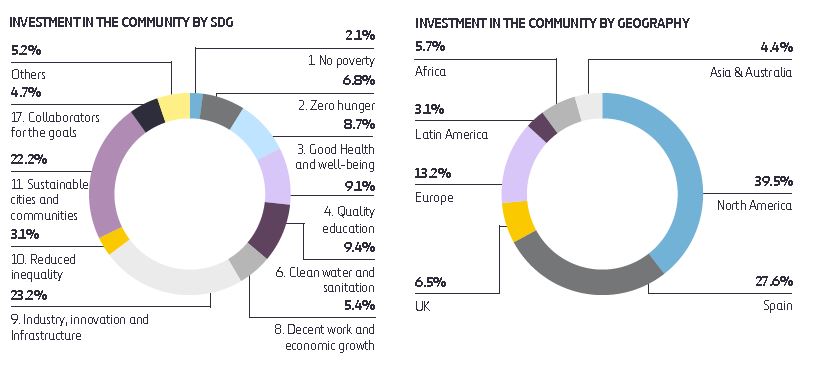
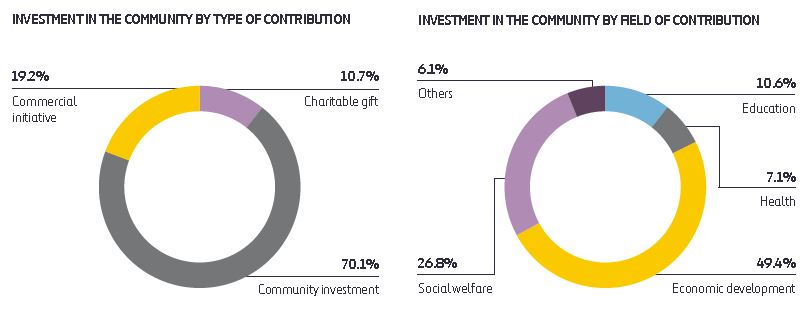
Ferrovial ensures that its actions align with its broader sustainability strategy by maintaining an active commitment to communities, consulting them through periodically materiality studies, and evaluating the effectiveness of these initiatives with measurable indicators. Ferrovial applied Social Return on Investment (SROI) indicators to measure impacts in the regions where it operates. This methodology contains around 100 different indicators, which are selected based on the construction project and are the most appropriate for portraying Ferrovial’s impact in the region. The information is collected before the beginning of the project, one year later, and two years later, thus ensuring that all impacts are correctly recorded. Ferrovial has calculated that over the years it has obtained a return on investment of €9.4 for every euro invested in the project. These efforts not only mitigate potential risks but also generate material opportunities, such as promoting local economic growth and improving living conditions.
In recent years, no material negative or systemic impacts on communities (neighbors, neighborhood associations, Councils, among others) have been identified, nor have there been reports of any serious issues or human rights violations affecting these communities. To proactively address potential negative impacts, Ferrovial has launched several initiatives tailored to the diverse range of potential impacts that its activities may have. Due to the wide variety of activities carried out by Ferrovial, a different action plan is applied for each of the impacts identified. All projects ensure communication with affected communities through the aforementioned activities to identify these impacts. However, these are resolved on a case-by-case basis. One example of this is the construction of the HS2 where, to keep community informed and understand their points of view they established monthly Community liaison meetings, Mobile Visitor Center events, local village hall drop-in sessions – to provide information when potentially disruptive packages of Works arise, and they distribute advanced Works notifications (AWNs) with details of the Works. Ferrovial remains committed to continuous improvement and delivering measurable long-term results, promoting the sustainable development of local communities and strengthening their relationships with them.
In terms of the foster of positive impacts, Ferrovial highlights its social investment initiatives, such as drinking water and sanitation programs, which have benefited more than 399,000 people in vulnerable communities. In terms of risk and opportunity management, the Company conducts regular assessments, identifying and managing ESG risks through robust governance processes and risk analysis tools.
S3-5: TARGETS RELATED TO MANAGING MATERIAL NEGATIVE IMPACTS, ADVANCING POSITIVE IMPACTS, AND MANAGING MATERIAL RISKS AND OPPORTUNITIES
Ferrovial has not established quantitative targets in this area. however, Ferrovial, within the framework of its 2030 Sustainability Strategy and its alignment with the CSRD Directive, sets specific targets with specific deadlines to reduce negative impacts on affected communities and promote positive effects on such communities. To establish these targets, Ferrovial actively collaborates with affected communities, legitimate representatives, and sustainability experts, ensuring engagement processes in the definition, monitoring, and improvement of the targets, which allows for continuous adjustment based on lessons learned. Ferrovial is implementing a procedure for relations with local communities, as a first step in this progress in relation to the establishment of targets with local communities. The results are broken down in detail according to their impact on the relevant affected communities, ensuring their specificity, temporal stability, and comparability, with the support of global standards such as the United Nations Global Compact, GRI standards, and the EU Taxonomy.
With the aim of evaluating suppliers and reducing supply chain risk, Ferrovial Construction has set itself the target of evaluating suppliers representing at least 60% of its 2025 purchasing volume. This target is aligned with Ferrovial Construction’s sustainability strategy, demonstrating its commitment to sustainable procurement practices.