ENVIRONMENTAL INFORMATION
ESRS E3 Water and marine resources
MANAGEMENT OF IMPACTS, RISKS AND OPPORTUNITIES, AS WELL AS METRICS AND TARGETS UNDER THE ESRS E3.
| Stage* | Description | Likelihood of occurrence |
Time horizon | |
| Water | ||||
| (+) Impact | OP, Pt, Pu | Increase in water availability, efficient water use, and improvement of water quality through Cadagua’s operations. | Current | S |
| Opportunity | VC | Through Cadagua, Ferrovial contributes to addressing the impacts of climate change on water resources, by focusing its business activities on the design, construction, operation and maintenance of water treatment facilities, thereby supporting the availability of resources in the natural environment and for human consumption. | S | |
| (-) Impact | OP, Pt, Pu | Water extraction, consumption, and discharge in areas of water stress (including surface water and marine resources). | Current | S |
* OP: Own operations; VC: Value Chain; Pu: Purchases; C: Customers; Pt: Partners; S: Short term; M: Medium term; L: Long term.
E3 - 1: POLICIES RELATED TO WATER AND MARINE RESOURCES
| Policy | Water policy |
|---|---|
| Description | Ferrovial, through its Water Policy, recognizes water as a finite and irreplaceable natural resource and access to water as a fundamental human right, directly linked to global change and a necessary and key element within the circular economy.
Once its value both for the Company’s processes and the environment has been identified, it focuses its water management strategy on the availability of the resource, its quality and the balance of the ecosystems in which it is located. The Water Policy, as shown in the table, addresses the following issues:
|
| Objective | The objective of this policy is to define and establish the principles and criteria governing actions in the field of water use and management. |
| Associated material impacts, risks and opportunities |
|
| Follow-up and remediation process | Ferrovial deploys its policies through the corresponding strategies, which in turn define governance schemes and indicators with objectives and monitoring procedures that allow the efficient management of the integral water cycle and its responsible use in the Company’s direct operations to be continuously monitored and evaluated, optimizing the balance that results in the Group’s water footprint. |
| Scope of the policy | |
| Affected stakeholders | Ferrovial promotes the principles of the Water Policy among all its stakeholders. In terms of scope, this policy applies to:
|
| Geographic areas | Global |
| Value chain application | As it affects all stakeholders, the scope of this policy covers the entire value chain. |
| Exclusions from the application | There are no exclusions from application. |
| Policy approval flow | |
| Responsible party | The Board of Directors approves the Sustainability Policy, which is implemented through additional more specific policies, such as the Quality and Environment Policy and the Water Policy (the implementation of both policies is overseen by the Quality and Environment Committee). |
| Other issues to report (if applicable) | |
| Consistency with third-party instruments or standards | Ferrovial’s water policy is aligned with internationally recognized standards, adhering to the principles set out in The Water Footprint Assessment Manual, the Global Water Tool (GWT) and the Global Reporting Initiative (GRI-G4). These frameworks guide the Company’s methodology for calculating and reporting on its water footprint, ensuring a comprehensive analysis of water-related risks and opportunities across its operations. |
| Stakeholder engagement | Ferrovial’s Water Policy incorporates the interests of key stakeholders by addressing regulatory requirements, the sustainable use of water resources, and operational efficiency. Ferrovial also takes into account the needs of local communities by implementing measures to reduce water consumption, improve efficiency and minimize its impact on shared water resources. In addition, the policy promotes transparency by monitoring and reporting water use in accordance with recognized frameworks, ensuring transparency to investors, customers and other stakeholders. |
| How it is made available | This policy is available on Ferrovial’s website (ferrovial.com) and through the internal communication channels. |
| Significant policy changes | N/A – no changes were made. |
To this end, indicators, targets, monitoring procedures and strategies have been established that allow continuous control and evaluation of water management in the direct operations of the Company, optimizing the balance that results in the Group’s water footprint. The Company’s own water footprint calculation methodology takes into account the water stress factor of each region in which it operates, assigning greater impact to the catchments of the areas with greater water stress, with special emphasis on the management practices implemented in those areas. In addition, as set out in Ferrovial’s Water Policy, the Company supports the development and use of new technologies that allow for a more efficient use of water resources (more information in E3-2 section).
The Quality and Environment Policy includes compliance with environmental regulations, focusing on minimizing the Company’s impact and preventing pollution. To this end, the best practices are applied to prevent the pollution of the environment in which the Company’s activities are carried out and contingency plans are established when necessary.
In the context of growing demand for drinking water and deterioration of quality due to pollution, the Company, through its subsidiary Cadagua, plays a key role in water management, contributing to addressing major challenges regarding water supply, quality, sanitation and pollution, especially in areas with water scarcity.
In addition, in line with the global strategy to promote sustainable infrastructure, the Company supports the development of infrastructure assets that foster access to basic rights such as water to vulnerable communities through the social infrastructure initiatives, which provide access to drinking water and sanitation to populations in developing countries.
In order to minimize those negative IROs identified in the Double Materiality Assessment, the Water Policy already contains some principles to carry out such mitigation:
- Responsible and efficient management of water resources, taking into the entire water cycle, promoting social development and the conservation of the ecosystem.
- Integration of water use and management into the Company’s risk management strategy.
- Establishment of indicators, targets, monitoring procedures and strategies that allow for the efficient management of the entire water cycle, and its responsible use in the Company’s direct operations to be continuously monitored and evaluated, optimizing the balance that results in the Group’s water footprint.
In addition, the methodology established for the calculation of the water footprint allows for efficient management of water resources in each geographical region, considering the level of country-specific water stress. At the local level, both the sources of water extraction and the discharge destinations are evaluated to minimize environmental impacts. Projects also implement local measures aimed at reducing water consumption throughout the entire life cycle of the infrastructure, encouraging water reuse. This includes adopting strategies to prevent water pollution during the construction and operational phases of buildings and infrastructure. Examples of these actions include the installation and maintenance of the necessary devices and mechanisms to guarantee water quality that may be affected by activities, such as pollutant retention ponds and sediment barriers.
E3 – 2: ACTIONS AND RESOURCES RELATED TO WATER AND MARINE RESOURCES
As a user of water resources and provider of water-related resources, the Company manages water responsibly and efficiently, taking into account the entire water cycle, from groundwater and surface water to wastewater, promoting both social development and the preservation of ecosystems.
Through its subsidiary Cadagua, the Company plays a key role in the management of water resources, helping to address major challenges related to supply, quality, sanitation and pollution, especially in areas with water scarcity. In this regard, the Company is working on the application of advanced treatments to eliminate contaminants of emerging concern, as well as antibiotic-resistant bacteria.
The Company has implemented actions to address environmental challenges related to water resources, some of them in areas of high-water stress. Ferrovial’s own water footprint methodology obtains water stress factors for each country where it operates from the Aqueduct Water Risk Atlas tool. Areas categorized as Medium-high or High are considered as water-stressed, while areas categorized as Extremely-high are considered high water-stressed. These main actions are carried out on an ongoing basis depending on the type of project, and some of the main good practices are detailed below:
Construction activities
- LINEA CIRCULAR METRO OPORTO: On the construction site of Porto’s circular metro line (Portugal), water generated during excavation and tunneling works is being reused for various construction activities. These include foundation works and soil improvement through jet-grouting, as well as general site cleaning and dust-suppression watering.
This reuse strategy aims to reduce the consumption of potable water, minimise waste, and promote a more sustainable construction process. Since the beginning of the project, a total of 85,931 m³ of water has been successfully reused. In 2025, 21,642 m³ of water have been reused, demonstrating the project’s commitment to resource efficiency and circular-economy principles even more important in water stressed areas.
- LINEA 8 BARCELONA METRO: Ferrovial Construction is in charge of the Line 8 of the Barcelona Metro (Catalonia, Spain) construction. The project faces the challenge of operating in the context of a prolonged drought in Catalonia. Water-saving measures were proposed within the scope of the project to reduce water consumption and thereby help mitigate the situation as much as possible.
Consequently, it was decided to propose changes in construction procedures for certain items, such as the case of the piles. The type of piles used has enabled an execution methodology that results in an estimated saving of 300 m³ of water. Furthermore, a different type of bentonite slurry has also been selected for piling works, which reduces the water consumption required for its production and increases efficiency in its use, leading to an estimated total saving of more than 10,000 m³. Furthermore, the tunnel boring machine (TBM) used for the construction of the metro tunnel requires large volumes of water which is why alternatives such as the use of groundwater are being explored.
Cadagua, water treatment activities
- ETAP DEL TER: In relation to the improvement and optimisation of water treatment processes, Cadagua, together with its partner, has begun the execution of the expansion and rehabilitation works of the Ter Drinking Water Treatment Plant (DWTP), the largest water treatment plant in Catalonia (Spain), with a treatment capacity of 8 cubic meters per second (8 m³/s) and four tanks capable of up to 557,664 m3. The concession has a budget of 102 million euros and an execution period of 48 months.
In this contract, whose works are progressing satisfactorily, Cadagua is implementing an innovation project focused on the incorporation of Activated Carbon and Ozonation—technologies that guarantee quality and aim to enhance the sensory properties of water while eliminating traces of emerging contaminants such as pharmaceuticals present in surface waters influenced by anthropogenic activity.
Regarding the innovative tasks, during 2025 the adsorption isotherm tests were completed at the laboratories of the AINIA technology centre. These tests compared up to seven different activated carbons against three distinct emerging contaminants, providing key insights into their adsorption capacity. Currently, rapid filtration column tests are being conducted to determine the breakthrough point and assess which carbons exhibit earlier exhaustion, enabling the selection of the most efficient material for the final phase. In parallel, work has commenced on adapting the pilot plant at the water treatment facility, where the third phase of the research project under this significant contract will be carried out, with the objective of validating the performance of the selected carbons under real operating conditions.
For more information on corrective measures related to affected communities, see section “ESRS S3-3: Processes To Remediate Negative Impacts And Channels For Affected Communities To Raise Concerns”.
These actions are part of Ferrovial’s broader commitment to sustainability and the preservation of the natural environment, and are aligned with its sustainability and water resources management strategy.
By the end of 2025, 277 employees4 were working in the various Quality and Environment departments of Ferrovial and its subsidiaries, representing an expenditure of approximately 18.69 million.
The water management strategy takes into account water resources in terms of availability (water stress), quality and balance of the ecosystems on which it has an impact, so the policies and actions described above are applied with the highest level of rigor in all the natural environments in which the Company operates.
In addition, in those regions and activities in which permits are required for the consumption of surface or groundwater, these are obtained taking into account the joint rational exploitation of the resources and, therefore, their concession takes into account the forecasts established in the applicable hydrological plans.
E3 – 3: TARGETS RELATED TO WATER AND MARINE RESOURCES
As explained in the following section, Ferrovial developed a methodology based on internationally recognized standards for the calculation of the water footprint, which enables water management to be carried out at geographical level.
The Company has set the following targets in relation to its water footprint:
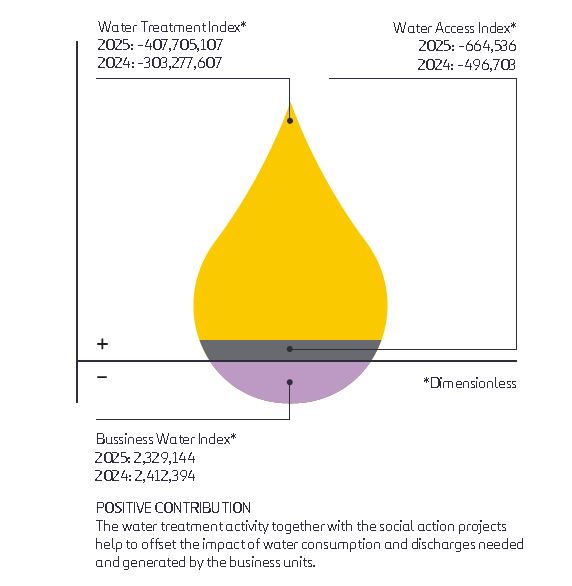
- Reduce Business Water Index (BWI) by 20% by 2030 (base year 2017 data is 3,110,263). In 2025, a reduction of 25.1% compared to 2017 (-3,5% compared to 2024) was achieved. The target-year value is 2,488,210. This objective implies the reduction of water consumption across Ferrovial’s businesses, as well as discharges, taking into account the water stress of the regions in which it operates.
- Annual compensation 70 times the BWI [Water Treatment Index (WTI) + Water Access Index (WAI)] > 70 BWI. In 2025, 175 times the BWI was compensated (1265 in 2024). This target takes into account the improvement of water quality, as the BWI is offset by the positive impact of the WTI and the WAI.
Ferrovial’s objectives apply to the Company´s financial consolidation scope and were set on a voluntary basis. Trend analyses, as well as the requirements of analysts and investors, were considered when setting these objectives. Targets were also established in accordance Water Policy principles, with a focus on the efficient and responsible use of water and the search for solutions to reduce the water footprint. The Company continuously evaluates the effectiveness of its water-related goals and initiatives through internal assessment processes.
4 This indicator does not include Budimex (see note 2.2 of the Consolidated Annual Accounts for further information).
5 For more information see ESRS S2, BP-2.
E3 – 4: WATER CONSUMPTION
WATER WITHDRAWAL (ENTITY-SPECIFIC INDICATORS)
| 2022 | 2023 | 2024 | 2025 | |
|---|---|---|---|---|
| Total extraction of water | Total extraction of water | Total extraction of water | Total extraction of water | |
| Supply network (m3) | 931,346 | 1,115,436 | 1,362,930 | 1,416,596 |
| Surface freshwater (m3) | 343,306 | 328,462 | 204,525 | 74,556 |
| Groundwater (m3) | 658,167 | 629,316 | 717,009 | 599,495 |
| Rainwater (m3) | 6,580 | 181 | 0 | 2,882 |
| Water from wastewater (m3) | 0 | 0 | 21 | 0 |
| Pre-treated water in Cadagua (m3) | 4,699,448 | 4,321,764 | 4,668,729 | 4,328,765 |
| Recycled water – reused (m3) | 21,899 | 43,765 | 65,960 | 45,023 |
| Total | 6,660,746 | 6,438,924 | 7,019,174 | 6,467,317 |
Note:
• 2024 data have been restated due to needed corrections in data found during the reporting year. For groundwater, 2022 and 2023 data has also been restated. For more see BP-2.
• The information on water withdrawal indicators for the jointly operated projects HS2 Main Works and Ontario Transit Group Constructor GP, which are proportionally consolidated, are not included. This information does not represent a relevant deviation in the disclosed metrics.
WATER DISCHARGE
| 2022 | 2023 | 2024 | 2025 | |
|---|---|---|---|---|
| Total (m3) | 217,820 | 178,108 | 241,126 | 250,300 |
Note: The information on water discharge indicators for the jointly operated projects HS2 Main Works and Ontario Transit Group Constructor GP, which are proportionally consolidated, are not included. This information does not represent a relevant deviation in the disclosed metrics.
WATER CONSUMPTION*
| 2022 | 2023 | 2024 | 2025 | |
|---|---|---|---|---|
| Total water consumption (m3) | 6,442,927 | 6,260,816 | 6,778,048 | 6,217,017 |
| Water consumption intensity (m3/€M)¹ | 853.25 | 735.27 | 740.93 | 645.79 |
| Water consumption in water-stressed areas (m3) | 6,207,185 | 6,076,994 | 6,578,686 | 5,882,057 |
*According to the water footprint methodology, water-stressed areas refer to the countries in which the Company operates: Australia, Chile, Colombia, Spain, France, Poland, Portugal and Turkey.
¹This ratio has been calculated based on the revenues included in the Profit and Loss Statement of the 2025 Financial Statements.
Notes:
• 2024 data have been restated due to needed corrections in data found during the reporting year. For total water consumption, 2022 and 2023 data has also been restated. For more information see BP-2.
• The information on water consumption indicators for the jointly operated projects HS2 Main Works and Ontario Transit Group Constructor GP, which are proportionally consolidated, are not included. This information does not represent a relevant deviation in the disclosed metrics.
Ferrovial is committed to sustainable practices and the responsible management of water resources. The methodology established for the calculation of the water footprint allows for the efficient management of water resources across each geographical area, taking into account the country-specific level of water stress. At the local level, both sources of water withdrawal and discharge destinations are assessed to minimize environmental impact. In addition, projects implement measures to reduce water consumption and encourage water reuse, including measures to prevent water pollution.
The calculation methodology is Ferrovial’s proprietary methodology and has been developed according to the principles of The Water Footprint Assessment Manual (WFM) and the Global Water Tool (GWT), two internationally recognized references for the calculation of water footprint assessment. This methodology takes into account the source of water withdrawal, assigning different weights depending on its origin, the country’s water stress and the destination of the discharges and their quality according to the treatment they have received. It is composed of three indexes:
- Business Water Index (BWI): measures the negative impact produced by activities as a result of water consumption and discharges generated.
- Water Treatment Index (WTI): measures the positive impact of the water treatment processes carried out at Cadagua’s facilities.
- Water Access Index (WAI): determines the positive impact of social action projects aimed at improving access to water and sanitation in vulnerable
communities.
Data on water according to the different sources is obtained directly from the contracts of each of the business lines, using the different existing information systems available, given the diversity of operational activities. Data is consolidated at the corporate level with the water footprint tool used to prepare this report. For reporting purposes, financial control is considered the organizational boundary. In relation to the requirements of the ESRS, the scope of the water footprint includes the entire financial consolidation perimeter Under this approach, the Company accounts for data from those sources over which it has full authority to introduce and enforce its operational policies, regardless of their stake in the Company.